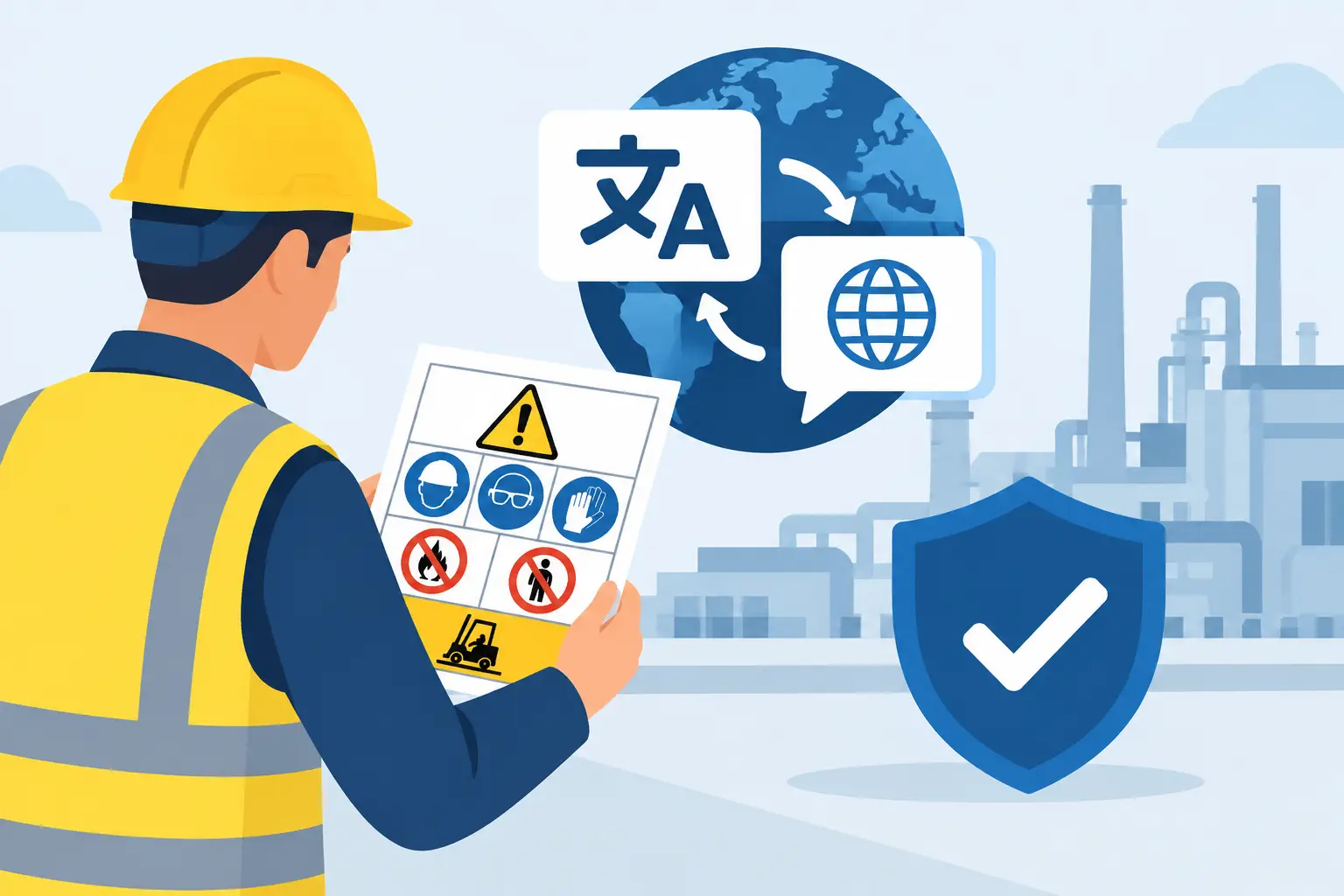
A warning label on a chemical drum, control panel or emergency isolation point has one job: make the right action unmistakable before someone is harmed. Are translated safety labels compliant? Only when the translation is one controlled part of a wider compliance process. A grammatically correct label can still fail if its terminology, symbols, placement, durability or regulatory wording are wrong.
For industrial operators, that distinction is not academic. A mistranslated instruction during a plant handover can lead to unsafe maintenance. An omitted hazard statement can create regulatory exposure. A vague label on a new production line can undermine training, delay commissioning and leave the employer defending an incident that should have been prevented.
Translation alone does not make a safety label compliant
A translated safety label is compliant when it communicates the required safety information accurately, in the legally required language or languages, and in a form that meets the rules applying to that product, workplace or substance. Translation is therefore necessary in many cross-border projects, but it is never the only test.
Compliance may depend on the type of label. Chemical packaging, machinery markings, workplace safety signs, electrical equipment labels and process-control labels all sit under different requirements. A label on a container of hazardous material must not be treated in the same way as an internal instruction fixed to a pump or a temporary warning used during construction.
In Hungary, as elsewhere in the EU, the language provided must be suitable for the users and the market concerned. For products placed on the Hungarian market, Hungarian-language information is commonly required. If a multinational workforce operates a site, Hungarian alone may not be sufficient to control the real operational risk. Workers must be able to understand the instruction reliably at the point of use.
This is where many projects go wrong. A procurement team may request a direct translation to meet a documentation deadline. Yet the people working on the equipment may use different terminology, follow a different isolation procedure or understand a technical phrase differently from the person who approved the artwork.
What makes a translated label defensible?
The question is not whether the words have been translated. The question is whether the final label enables safe, compliant action in the actual working environment.
For hazardous chemicals, the classification and labelling framework determines mandatory elements such as hazard pictograms, signal words, hazard statements and precautionary statements. These phrases cannot be freely rewritten for style. Their approved wording, substance classification, concentration details and package information must be checked against the applicable requirements.
For machinery and industrial equipment, the label must also reflect the manufacturer’s risk assessment and the instructions supplied with the machine. A translation that turns “isolate all energy sources” into “switch off power” is not a minor wording issue. It may ignore pneumatic, hydraulic, thermal, gravitational or stored electrical energy. That is a potentially fatal change in meaning.
Workplace labels and signs require the same discipline. The relevant symbol may be recognised across languages, but a symbol does not replace a clear instruction where the task or risk is complex. “Authorised personnel only” and “Do not enter during automatic cycle” serve different purposes. Translating one as the other changes who may enter the area and when.
A defensible review should confirm at least five areas:
- the correct legal and site language requirements;
- approved technical and safety terminology;
- mandatory wording, symbols, units and warning hierarchy;
- consistency with risk assessments, procedures and training material; and
- physical suitability, including visibility, contrast, location and resistance to heat, chemicals or abrasion.
A label may be linguistically accurate yet still be non-compliant because the text is too small, the pictogram is incorrect, the adhesive fails in an outdoor environment or the warning is placed where it cannot be seen before the hazard is encountered.
Where translated safety labels most often fail
The most expensive errors tend to appear at the boundary between language and engineering. General translation providers may understand the sentence but not the process behind it. In technical safety communication, that process is the meaning.
Consider a petrochemical maintenance shutdown. A German source label refers to a specific shut-off point and a defined lockout sequence. If the Hungarian translation uses a broad term for “valve”, rather than the site’s established term for the isolation valve, a contractor may act on the wrong component. The label did not merely read badly. It introduced an operational deviation.
Automotive plants face a similar risk when imported fixtures, robotic cells and test stations arrive with mixed-language labels. Local teams may add quick translations during installation, while the original manufacturer documentation is revised elsewhere. After several changes, the warning on the equipment, the standard operating procedure and the training slide deck no longer say the same thing. At audit, inconsistency becomes evidence that safety information has not been properly controlled.
There is also a recurring problem with machine translation. It can assist with low-risk internal drafts, but it cannot determine whether “guard”, “interlock”, “earthing”, “purge” or “relief” has a specialised meaning in a particular system. It also cannot validate a regulated phrase against the source classification or recognise that a short label has been deliberately written to distinguish an emergency instruction from a routine one.
The commercial consequences are immediate. Incorrect labels can hold up acceptance testing, trigger relabelling across an installed fleet, delay a site opening or create a corrective-action burden during an audit. If an incident occurs, the cost expands to investigation, downtime, legal exposure and reputational damage.
A practical process for compliant translated labels
The safest approach starts before translation. First, identify what the label controls: chemical handling, access, energy isolation, emergency response, safe operation, transport or maintenance. Then establish which legislation, standards, client specifications and internal procedures apply. This prevents a team from using a generic translation workflow for a regulated label.
Next, collect the approved source material. This should include the current risk assessment, safety data sheet where relevant, equipment manuals, process and instrumentation terminology, existing site signage and controlled vocabulary. Translators should not be asked to infer safety-critical meaning from a photograph and a spreadsheet column.
The translation itself should be completed by a linguist with relevant industrial knowledge. The reviewer must be able to challenge ambiguous source text, identify terminology conflicts and preserve the intended instruction level. In a high-risk project, an EHS specialist, process engineer or equipment owner should then validate the target-language content against the real equipment and task.
After linguistic and technical approval, review the artwork. Check line breaks, truncated text, font size, pictograms, warning colours and label position. A phrase that fits in English or German may need more space in Hungarian. Shrinking the type until it becomes unreadable is not a design compromise. It is a safety failure.
Finally, control the released version. Record the source document, translation version, reviewer, approval date and installation location. When procedures or equipment change, the label must be reviewed as part of the change-control process. A compliant label at commissioning can become misleading after a modification.
Why spoken technical support matters during rollout
Labels do not exist in isolation. They are installed, explained and tested during meetings, training, audits and commissioning activities where several languages may be in use. If the interpreter does not understand the terminology behind the label, the workforce may receive a different message from the one printed on the equipment.
This is particularly significant during factory construction, plant upgrades and SAP-led process changes, when teams are working under time pressure and responsibilities cross national borders. A specialised technical interpreter can keep discussions about warnings, procedures, permit conditions and corrective actions aligned with the approved terminology. BeneDictum supports this type of high-stakes communication by matching technical language expertise to the industrial context rather than treating safety terminology as general business language.
The goal is not to create more paperwork. It is to ensure that an operator, contractor, supervisor and auditor all understand the same instruction in the same way.
Before releasing a translated safety label, ask a direct operational question: could the person standing in front of this equipment act safely, without guessing, in the language they actually use at work? If the answer is anything less than certain, the label needs further review.
0 Comments