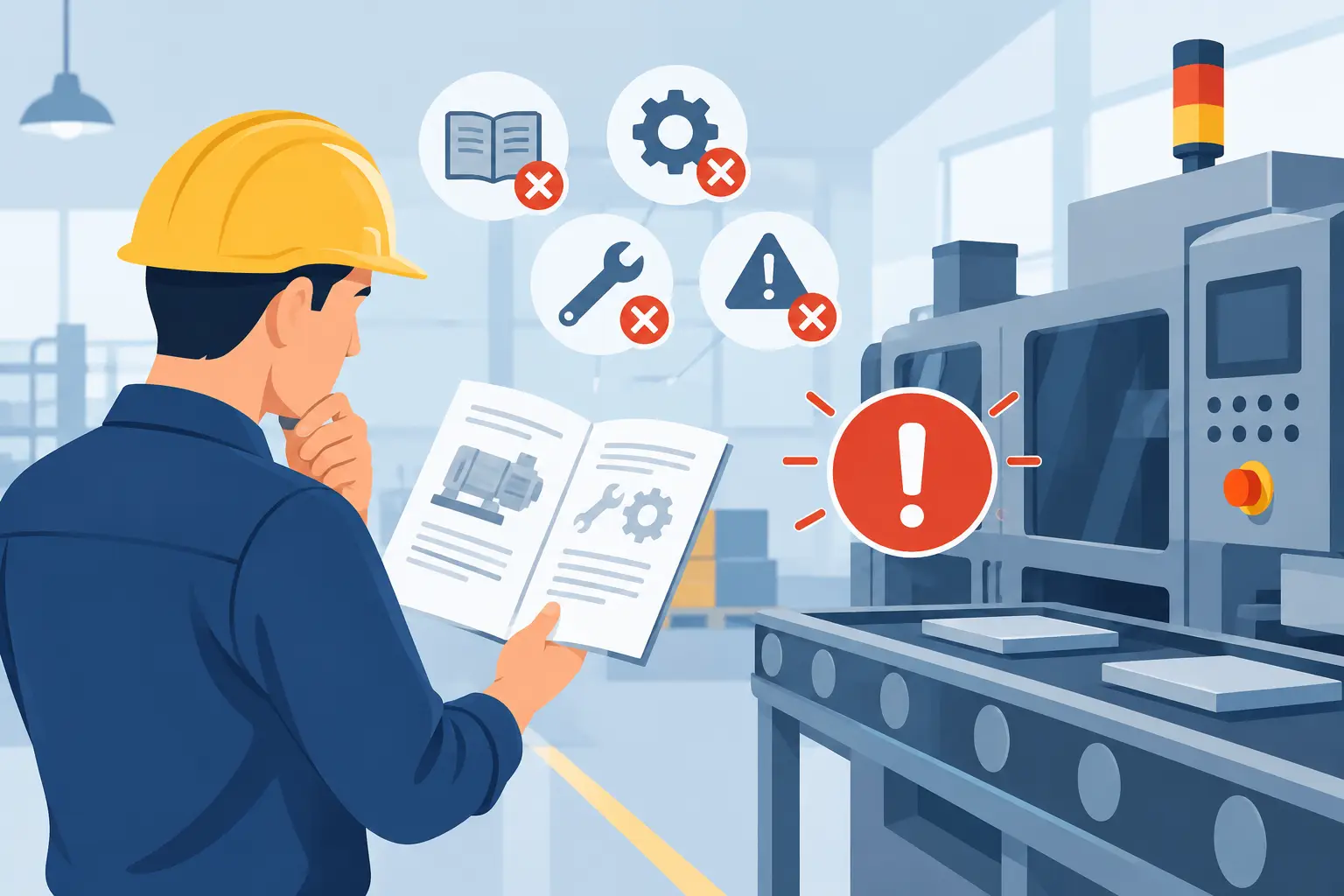
A manual may be technically complete and still fail on the factory floor. If an operator misunderstands a torque value, bypasses a lockout step or follows the wrong maintenance interval, the result is not a minor documentation issue. Equipment manual mistakes can cause injuries, damaged assets, failed audits, delayed commissioning and production losses that quickly exceed the cost of getting the document right.
For industrial businesses working across languages, the risk rises further. A machine supplier may issue documentation in German, a commissioning team may work in English, and local operators may need clear Hungarian instructions. Every version must carry the same engineering meaning. Anything less creates uncertainty precisely where certainty is required.
Why equipment manual mistakes become operational risks
Equipment manuals sit at the point where engineering design becomes real-world action. They tell people how to install, operate, clean, inspect, isolate, repair and restart machinery. A single unclear instruction can travel through an entire operation: from initial installation to operator training, preventive maintenance and emergency response.
The most dangerous errors are often not obvious spelling mistakes. They are small changes in meaning. “Secure” may be translated as “tighten”, although the original procedure requires a locking mechanism. “Shut down” may be treated as switching off a control panel, when the process actually requires full electrical and pneumatic isolation. A missing unit, decimal separator or reference to a drawing revision can make an otherwise credible manual unsafe.
The commercial impact is equally direct. If a contractor installs a component incorrectly, the commissioning schedule moves. If operators receive unclear instructions, supervisors spend time correcting avoidable errors. If maintenance teams work from inconsistent versions, a warranty claim may be rejected or a shutdown may last longer than planned. In regulated environments, poor documentation can also expose the business during an EHS investigation or quality audit.
1. Translating words instead of technical meaning
Literal translation is one of the most common equipment manual mistakes. General language skills are not enough when a term has a specific meaning in a particular plant, process or machine family.
Consider the difference between a valve being “closed”, “isolated” and “secured against operation”. In ordinary conversation these phrases may sound similar. In a petrochemical facility, they represent different physical conditions and different levels of risk. The same applies to terms such as interlock, bypass, purge, earthing, fail-safe position and emergency stop.
A qualified technical translator does not simply select the closest dictionary equivalent. They establish what the term means in that system, check the manufacturer’s terminology and apply the approved expression consistently throughout the manual, associated drawings and training material. This work becomes especially important when English and German source documentation is being prepared for a Hungarian operating team.
2. Losing critical numbers, units and tolerances
Text may be read quickly. Numbers should never be treated that way. A manual can contain values for pressure, voltage, temperature, torque, flow rate, clearance, concentration and timing. Any transcription, formatting or translation error in these fields can change the required action completely.
There are familiar traps. A comma used as a decimal separator in one document may become a full stop in another. A torque value may appear without its unit. A temperature may be converted unnecessarily, introducing rounding errors. A sentence that says “do not exceed” may be weakened to “avoid exceeding”.
Numbers should therefore be checked in context, not merely proofread as text. The reviewer needs to know whether 0.5 mm is a permissible clearance, a minimum setting or an alarm threshold. Tables, warnings, diagrams and callouts need the same level of control as running prose. It also depends on the equipment: a minor layout issue in a low-risk consumables guide is not equivalent to an incorrect set point in a boiler, press or chemical dosing system.
3. Breaking the connection between text and drawings
Industrial manuals rarely stand alone. They refer to electrical schematics, P&IDs, exploded parts diagrams, safety labels, software screens, maintenance plans and revision-controlled appendices. When translation or document formatting breaks those references, the manual becomes difficult to use under pressure.
A technician should not have to guess whether “Figure 6” is the wiring diagram for the old motor variant or the current one. Nor should an operator be directed to a warning label that has been translated differently from the manual. Where documentation has been updated over several project phases, obsolete figure numbers and part codes are common sources of confusion.
The solution is disciplined document control. Each reference should be checked against the final version, and terminology used in diagrams and labels should match the operating instructions exactly. During site acceptance, a technical interpreter can also help verify that the language used by the supplier, installer and local team corresponds to the delivered documentation.
4. Hiding safety actions inside dense paragraphs
A safety-critical instruction should not rely on a reader noticing one clause halfway through a long paragraph. Yet manuals frequently bury prerequisites such as isolation, depressurisation, cooling time or required personal protective equipment in explanatory text.
Clear structure matters because technicians often consult manuals while diagnosing a fault, not while sitting at a desk. The sequence needs to be visible: what must be checked before work starts, what action is allowed, what condition stops the task and what proves the system is safe to restart.
This does not mean every procedure needs excessive warnings. Too many generic cautions train readers to ignore them. The right approach is to make the specific hazard and control measure unmistakable. For example, distinguish between a general maintenance recommendation and a mandatory lockout-tagout procedure. The language should state responsibility and action without ambiguity.
5. Treating the manual as separate from training
A translated manual that is never tested in training is an unverified assumption. Trainers may use different terminology from the document, operators may interpret instructions differently, and questions from the floor may reveal gaps that were invisible during desktop review.
This is particularly relevant during factory construction, equipment relocation, SAP implementation or the launch of a new production line. A mixed-language team may receive a manufacturer briefing in German or English, while operators need to apply the procedure in Hungarian during their next shift. The spoken explanation and written instruction must reinforce one another.
Use training sessions as a practical validation point. Ask operators to locate the relevant instruction, explain the required sequence and identify the stop condition. If the answer varies between teams, the manual or the training language needs correction before the equipment enters routine operation.
6. Allowing terminology to change between documents
A machine manual, risk assessment, standard operating procedure, spare-parts list and maintenance work order may all describe the same component. If each document uses a different name, communication slows down and mistakes become more likely.
Terminology inconsistency is especially costly during breakdowns. A remote supplier may ask for the status of a “proximity sensor”, while the local team refers to the same item as an inductive switch and the maintenance system lists a third term. Time is then lost confirming what should have been clear.
A controlled glossary gives technical teams one approved term per concept, with accepted abbreviations where needed. It should be built from the actual equipment, client standards and industry usage, rather than from generic translation memory alone. BeneDictum applies this field-specific approach because terminology control is not editorial polish. It is a safeguard for operational decisions.
7. Publishing once and forgetting revision control
The manual delivered at commissioning is rarely the manual that will remain accurate two years later. Components are replaced, software versions change, guarding is modified and maintenance intervals are revised. If the operational team keeps an old translated copy while the supplier issues updates in another language, the site is effectively running two different systems of instruction.
Every controlled manual should show its revision status, issue date and relationship to drawings and procedures. Changes must be translated with the same care as the original document, then communicated to the people who use the equipment. A revised emergency procedure locked in a shared folder is not enough if contractors and shift teams still carry printed copies of the previous version.
Build verification into the document process
The strongest defence against equipment manual mistakes is not a final spellcheck. It is a controlled process involving technical translation, terminology approval, numerical and drawing checks, operational review and version management. The depth of review should reflect the consequence of failure.
Before a manual is released, ask a practical question: could the person standing in front of this equipment perform the task safely and correctly using this document alone? If the answer is uncertain, the documentation is not finished. Resolve that uncertainty before it reaches the plant floor, where every unclear instruction costs more to correct.
0 Comments