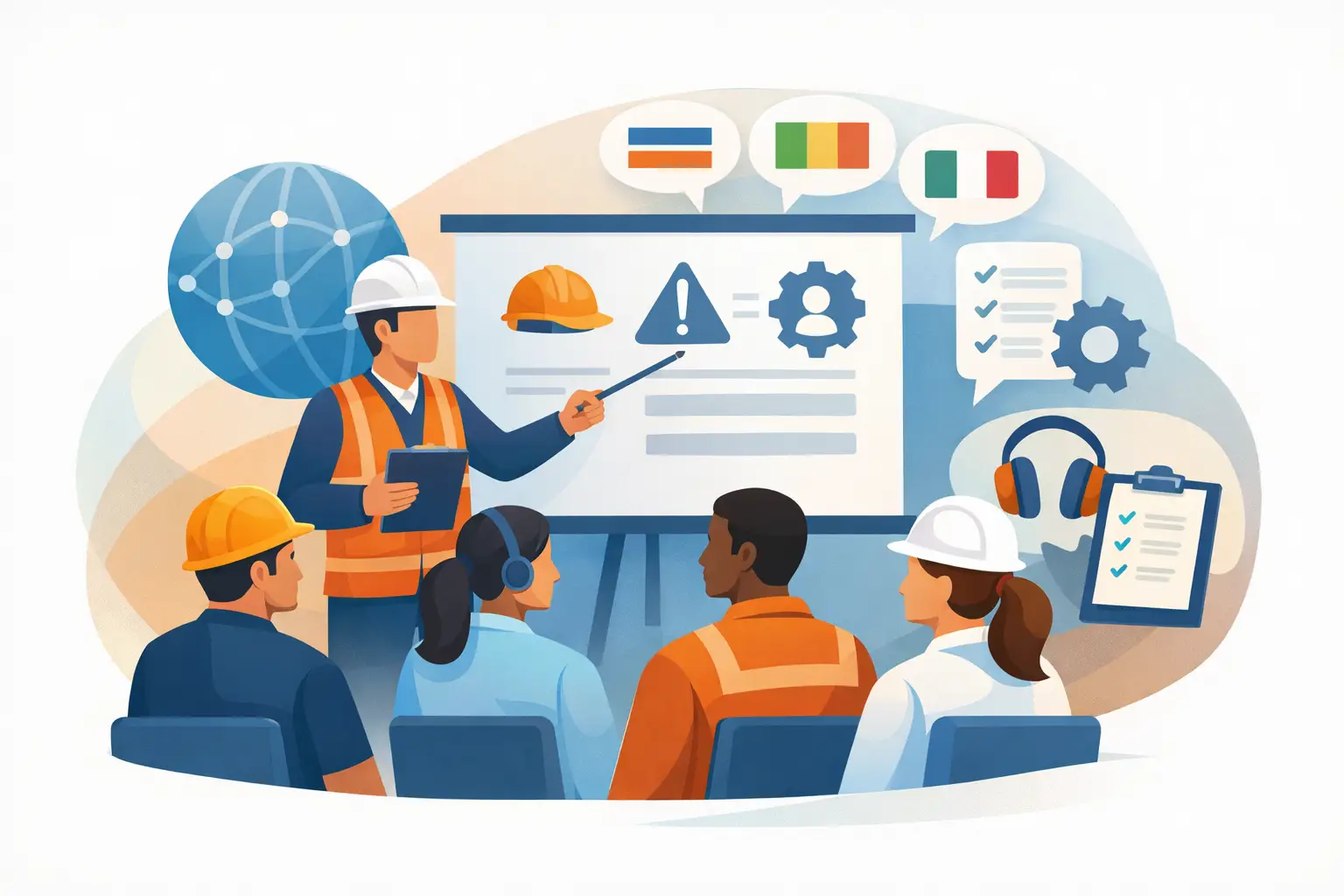
A safety induction fails long before the first slide appears on screen. It fails when a contractor nods without understanding a lockout instruction. It fails when a machine guard is described in vague language. It fails when a translated handout uses the wrong technical term and nobody catches it until work starts. That is why knowing how to prepare multilingual safety inductions matters in any industrial environment where mixed-language teams are entering live operational areas.
In manufacturing, energy, petrochemical and automotive settings, safety communication is not a courtesy. It is a control measure. If your induction is the first line of defence for visitors, subcontractors, commissioning teams or newly arrived operators, every word needs to do real work. The objective is not to translate more content. It is to make sure every attendee understands the right instruction, in the right way, at the right point of risk.
What multilingual safety inductions need to achieve
A multilingual induction should do three things without compromise. It must satisfy site compliance requirements, communicate actual operational hazards and confirm that attendees have understood what applies to their role. If one of those elements is weak, the induction becomes a paper exercise.
This is where many sites go wrong. They treat language as an administrative detail and assume a translated deck is enough. It rarely is. A strong induction has to account for reading level, technical vocabulary, local terminology on site, pace of delivery and the fact that some attendees may understand everyday English or German but not specialist safety language. There is a significant difference between understanding basic conversation and understanding confined space entry rules, permit controls or emergency isolation procedures.
How to prepare multilingual safety inductions without creating new risks
The safest process starts with scope, not slides. Before drafting or translating anything, define exactly who will attend. Are they civil contractors, electrical fitters, commissioning engineers, SAP users entering production areas, visiting investors or temporary agency workers? Each group needs a different level of detail, and in some cases a different format.
A short visitor induction for a plant tour should not look like a contractor induction for high-risk work. Equally, a generic site briefing is not enough for teams who will work around hazardous energy, chemical exposure or moving equipment. If you try to force one version on every audience, clarity suffers.
Once the audience is clear, identify the languages actually required on site. That sounds obvious, but assumptions are expensive. A project may be described as English-speaking because the senior engineers use English in meetings, while the installation crew relies on Hungarian, German, Ukrainian or another language in practice. Build your induction around the language of operational understanding, not the language of procurement documents.
Start with the site-specific hazards
Many induction packs are full of standard policy wording and very light on real conditions. That is backwards. Your multilingual content should begin with the hazards that can injure people on this specific site – traffic routes, overhead lifting, restricted zones, hot work rules, electrical isolation, chemical handling, PPE requirements, emergency alarms and reporting lines.
Then make sure the terminology matches what people will hear in the field. If the induction says one thing and supervisors use another term on the shop floor, confusion follows. This is especially dangerous in lockout-tagout procedures, permit systems and emergency response instructions, where near-equivalent wording is not good enough.
Build for spoken delivery, not just written translation
An induction is not merely a document. It is a live communication event. That means the wording must work when spoken aloud, often in noisy environments, under time pressure and to mixed groups with uneven language ability.
Dense paragraphs, legal phrasing and office-style language do not translate well into spoken safety communication. Short, direct phrasing is more effective. So is a clear sequence. People need to understand where they can go, what they must wear, what they must never do, how alarms sound and who they report to if conditions change.
If the induction includes technical demonstrations, videos or Q&A, plan those sections carefully. Consecutive interpretation may be suitable for smaller groups where interaction matters. Simultaneous support may be more efficient for larger sessions, but only if the setting and equipment allow for it. It depends on group size, risk level and the need for attendee questions.
Why terminology control matters more than most teams expect
In technical environments, language errors do not stay in the classroom. They move directly into operations. A mistranslated phrase in a general HR induction may cause inconvenience. A mistranslated instruction in a shutdown, installation or commissioning environment can stop work, create a compliance breach or contribute to an accident.
That is why terminology management should sit at the centre of how to prepare multilingual safety inductions. You need an approved glossary before final delivery. It should include site-specific equipment names, process terms, safety systems, emergency wording and any abbreviations used internally. This is particularly important on projects where teams from different countries bring their own technical vocabulary to the same site.
A general linguist may produce grammatically correct material that still fails operationally. Industrial interpreting requires field knowledge. In a power plant, refinery or automotive facility, technical meaning carries legal, procedural and financial weight. Precision is not cosmetic. It protects people and keeps the job moving.
Test understanding, not attendance
A signed attendance sheet proves very little. The real question is whether attendees can act correctly when exposed to risk. That is why multilingual inductions should include a practical comprehension check.
The best method depends on the workforce. For some groups, a short written assessment works well. For others, verbal confirmation, scenario questions or supervised demonstration is more reliable. If literacy levels vary, relying only on written tests can give a false sense of assurance. Someone may copy an answer without understanding the instruction.
Ask practical questions. Which alarm means immediate evacuation? Where is hot work prohibited? Who issues permits? What do you do before entering a restricted area? If someone cannot answer clearly in their working language, the induction is incomplete.
Use visuals carefully
Pictures, icons and colour coding can strengthen understanding, but they are not universal. A symbol may look clear to your EHS team and mean nothing to a subcontractor from another working culture. Visuals help most when they support precise spoken explanation rather than replace it.
Site maps, photographs of access points, examples of correct PPE and marked exclusion zones are useful because they reflect the real environment. Generic stock imagery is much less valuable. If a photo does not match the site, people stop trusting the material.
Common failures in multilingual safety inductions
The most common failure is last-minute preparation. A project team realises on Monday that twenty foreign contractors arrive on Wednesday, and someone is told to translate the slides quickly. That approach almost guarantees weak terminology, poor delivery planning and no time for review.
Another failure is assigning language support based only on fluency. Speaking two languages is not the same as interpreting safety-critical technical content. If your interpreter does not understand the difference between isolation, shutdown, earthing, venting and commissioning, risk enters the room immediately.
A third problem is inconsistency between departments. Operations, EHS, HR and contractors may all use slightly different wording for the same rule. Multilingual attendees then receive mixed messages from the induction, the permit office and the supervisor. Standardising language before the session is far safer than trying to correct confusion afterwards.
When to involve a specialist technical interpreter
If the induction covers high-risk processes, specialist equipment or mixed-nationality project teams, professional technical interpreting is not optional in any meaningful business sense. It is part of risk control. The cost of poor communication is usually far greater than the cost of getting it right.
This is particularly true during construction, start-up, maintenance shutdowns, audits and training linked to new systems or machinery. These are the moments when unfamiliar people, unfamiliar terminology and unfamiliar conditions collide. A certified technical interpreter with industry knowledge can bridge that gap far more effectively than a general language provider.
For companies operating in Hungary with international teams, this becomes even more relevant. A specialist partner such as BeneDictum can align spoken interpretation and technical translation so the terminology used in the induction matches the wording used in documents, training materials and site communication.
Make the induction part of site control, not a standalone event
The strongest inductions do not end when the session finishes. The language used there should continue into permits, toolbox talks, signage, supervision and incident reporting. Otherwise, understanding fades the moment attendees leave the room.
Treat the induction as the foundation of a multilingual safety system. If terminology is controlled, delivery is accurate and understanding is verified, you reduce more than immediate safety risk. You also reduce rework, disputes, delays and the hidden operational drag caused by unclear instructions.
If people are entering a hazardous environment and your message must be understood first time, prepare the induction with the same seriousness you bring to any other critical control. Safety language is not an admin task. It is part of safe operations.
0 Comments