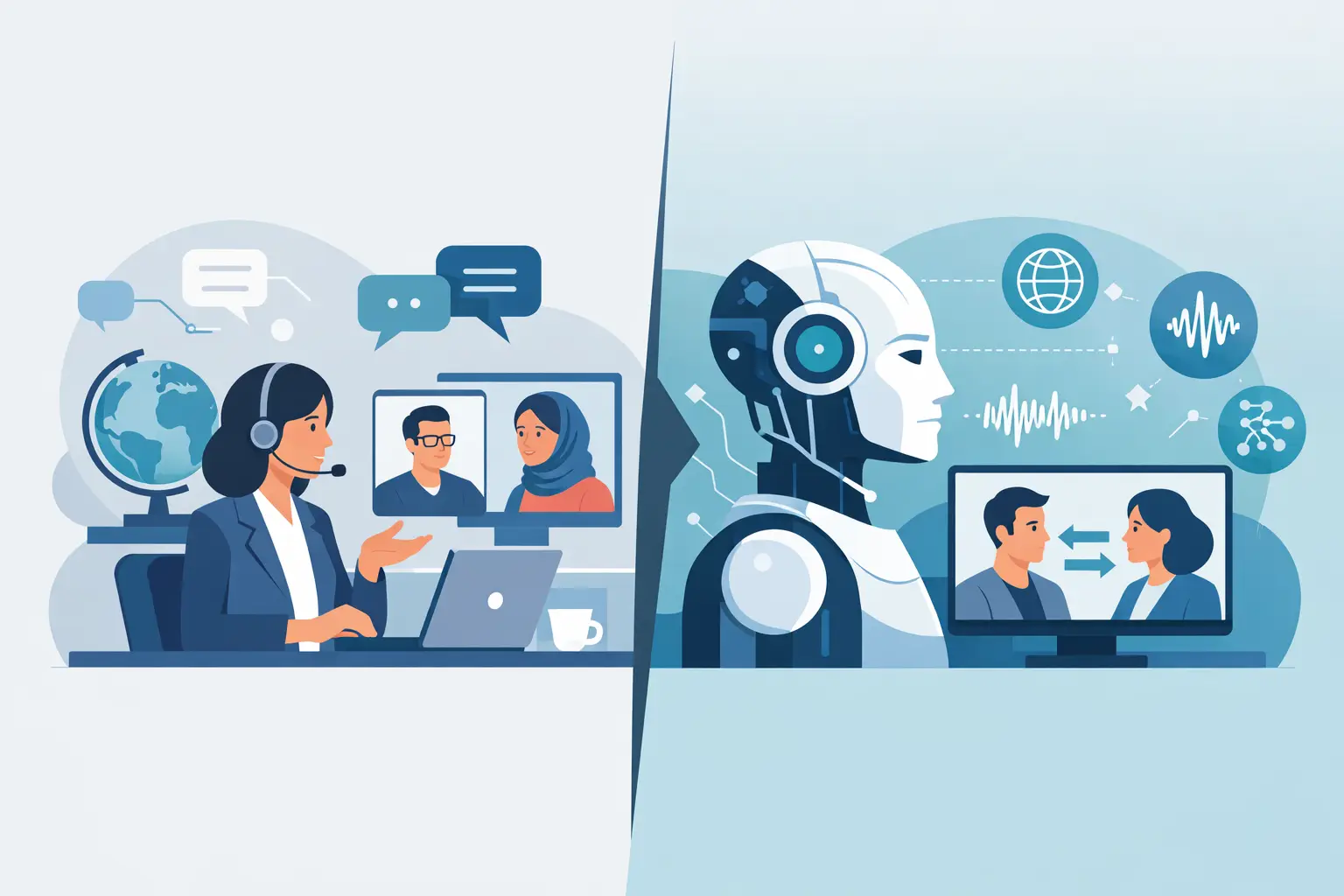
A commissioning meeting overruns by two hours. The German engineer says the pressure values are within tolerance, but the Hungarian team hears a different threshold. Nobody notices the mismatch until testing fails and the line stops. That is where the real debate around human interpreter vs AI translation begins – not in theory, but on factory floors, in control rooms and during high-stakes project meetings where one wrong term can trigger delay, rework or a safety incident.
For general communication, AI translation has become fast, cheap and often surprisingly usable. For technical business environments, that is only part of the picture. The question is not whether AI can translate words. It can. The question is whether it can carry meaning accurately enough when equipment, process safety, compliance and production continuity are on the line.
Human interpreter vs AI translation in technical settings
In industrial work, language is rarely just language. It is instruction, liability, sequencing and risk control. A phrase in a training session may refer to a machine state, a lockout step, a software field in SAP or a maintenance condition that has a precise operational consequence. When that phrase is translated loosely, the result is not merely awkward communication. It can mean an operator follows the wrong procedure or a contractor misunderstands a technical requirement.
AI translation performs best when the source text is clean, context is limited and the cost of slight ambiguity is low. It can help with internal notes, draft emails, quick orientation in foreign-language documents and basic multilingual exchange. It is often good enough for speed-first tasks.
A human interpreter works differently. A qualified technical interpreter does not just convert sentences. They track intent, terminology, speaker meaning, industry usage and situational context in real time. They also spot when the speaker is being vague, when a term could be interpreted in two ways, or when a statement does not fit the technical reality of the discussion. That intervention can prevent expensive misunderstandings before they spread through a project.
Where AI translation is useful
Used properly, AI has value. It can reduce administrative load and support preparation. A project manager may use it to scan foreign-language specifications before sending them for formal translation. A procurement team may rely on it to understand the broad meaning of supplier correspondence. A training coordinator may use it to draft rough bilingual material before technical review.
These are sensible uses because the text can be checked, corrected and refined. The timing is less critical, and the output is not the final authority.
AI can also assist in multilingual environments where speed matters more than precision. If a visitor needs simple directions around a site, or if teams are exchanging basic scheduling information, AI may be adequate. In those moments, the business risk is limited.
The problem starts when organisations mistake convenience for reliability. A tool that performs well in low-risk communication can appear more capable than it really is. That false confidence is where losses begin.
Where human interpreters still matter most
Consider a safety briefing before shutdown maintenance. The language used may involve permit conditions, isolation points, hazard categories and emergency procedure. If the interpreter misses the difference between inspection and approval, or between depressurised and isolated, the consequences can extend far beyond confusion.
Now consider an SAP implementation workshop. Teams are aligning system logic with operational reality across departments and languages. Terms that look similar on screen may have very different meanings in production, purchasing or quality control. AI may translate the label, but not the business process behind it. A human interpreter with technical and operational understanding can catch the mismatch while decisions are still being made.
The same applies during factory construction, line installation, equipment acceptance testing and investor site visits. These are not conversations where approximate meaning is enough. They require the interpreter to follow drawings, terminology, speaker hierarchy, meeting dynamics and technical intent at the same time.
That is why specialist interpreting remains a business-critical function in industrial sectors. It is not a premium add-on. It is a control measure.
Context is the real dividing line
The strongest argument in the human interpreter vs AI translation debate is context. AI can process language patterns. It does not truly understand the operational setting in which those patterns are used. It may offer a statistically likely phrase that sounds correct but is wrong for the process, equipment or regulation being discussed.
A human interpreter can ask for clarification, adapt terminology to the site context and recognise when a direct translation would mislead the listener. In a technical meeting, that judgement is often more valuable than raw speed.
Accountability changes the decision
There is also the question of accountability. If an AI tool mistranslates a maintenance instruction and the work is done incorrectly, who takes responsibility for that failure? In serious industrial environments, decision-makers need more than output. They need confidence in the process behind it.
A professional technical interpreter brings expertise, preparation and judgement. They can review glossaries, align with the project team, learn plant-specific terms and support communication consistently across meetings and milestones. That level of accountability matters when projects involve compliance, contractor coordination and significant capital expenditure.
Cost savings versus cost exposure
AI translation is often justified on cost. On paper, that argument is attractive. If software can produce a translation in seconds for a fraction of the fee, why pay for a specialist?
Because the real comparison is not fee versus fee. It is fee versus exposure.
If a poor translation contributes to a delayed start-up, repeated training, rejected work, software misconfiguration or safety non-compliance, the saving disappears immediately. In technical industries, the financial damage from one misunderstood instruction can exceed the cost of expert interpreting many times over.
This is especially true in energy, petrochemistry and automotive environments, where downtime is expensive and terminology is unforgiving. The cheapest language option is rarely the cheapest project outcome.
A practical way to decide
The most commercially sound approach is not to choose one side blindly. It is to match the communication method to the level of risk.
Use AI translation where speed is helpful, the material is non-critical and someone qualified can verify the output. Use a human interpreter where live communication affects safety, implementation, compliance, investment decisions or operational performance.
Ask four direct questions. Is the content technical? Is the communication live? Would an error cause delay, cost or danger? Does the discussion depend on industry-specific terminology? If the answer is yes to even two of these, human interpreting is usually the safer decision.
That is the point many businesses miss. The issue is not whether AI is useful. It is whether the communication can tolerate being nearly right.
The strongest model is often a combined one
For many industrial clients, the best answer is not human or AI, but both used properly. AI can support document triage, terminology preparation and low-risk internal communication. Human specialists should handle the meetings, audits, training sessions and project discussions where precision has direct operational value.
This blended approach keeps teams efficient without exposing the project to unnecessary risk. It also allows interpreters to work more effectively, because preparation materials can be processed faster while critical communication remains under expert control.
For companies operating in Hungary with multilingual teams, contractors and investors, this distinction is especially important. Site conditions are dynamic, project language is specialised and misunderstandings can escalate quickly. BeneDictum Kft. addresses exactly this problem by assigning certified technical interpreters according to field expertise, not just language pair, which is the difference between hearing words and understanding operations.
When the meeting concerns a plant shutdown, a commissioning sequence or a system go-live, nobody is looking for an elegant approximation. They need the right term, the right meaning and the right decision at the right moment.
AI translation will continue to improve, and sensible businesses should use it where it genuinely adds value. But in technical environments where mistakes are expensive and sometimes dangerous, human interpreters remain the safer choice because they do more than translate. They protect clarity when clarity has commercial consequences.
If your next multilingual discussion could affect safety, output or project delivery, treat language support as part of risk management, not administration.
0 Comments