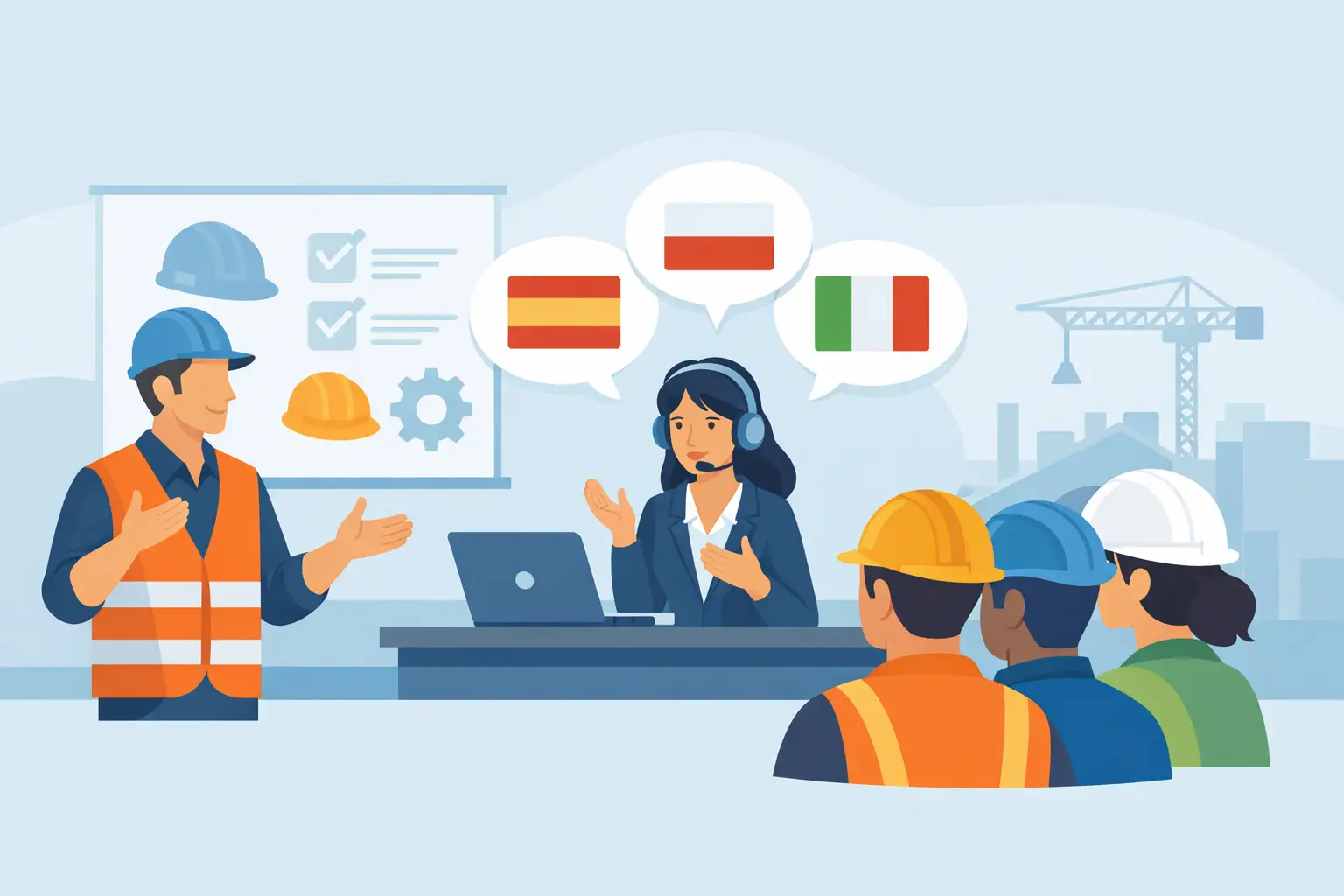
A toolbox talk that lasts ten minutes can prevent an injury, stop a shutdown or keep a commissioning schedule on track. It can also do the opposite if half the workforce does not fully understand it. That is why multilingual toolbox talk interpreting is not a nice-to-have on industrial sites. It is a control measure.
When safety instructions, permit conditions or changes to work sequences are delivered across multiple languages, every weak point in communication becomes operational risk. A vague phrase about lockout, lifting zones or confined space entry is not a language issue in the abstract. It is a site issue with immediate consequences.
Why multilingual toolbox talk interpreting matters on site
Toolbox talks sit at the junction of safety, production and accountability. They are short by design, often delivered under time pressure, sometimes outdoors, sometimes next to live operations, and usually to mixed groups with different first languages and different levels of technical knowledge. In that environment, even a competent bilingual colleague is rarely enough.
The problem is not only vocabulary. It is speed, context and precision. A speaker may refer to an isolation point, a hot work boundary, a temporary bypass, a revision to the lifting plan or a permit variation agreed an hour earlier. An interpreter without industrial experience may translate the general meaning but miss the exact technical instruction. That is where errors start.
On a construction, energy or manufacturing site, those errors are expensive. The direct cost might be rework, delay or failed induction. The indirect cost can be much higher – an incident investigation, damaged equipment, non-compliance finding or avoidable downtime that affects the whole project sequence.
What good interpreting changes in a multilingual toolbox talk
A strong interpreter does more than repeat words in another language. They preserve intent, risk level and technical meaning. If the supervisor says a valve is to remain mechanically locked and must not be treated as available for operation, the interpreter must carry that instruction across with no dilution and no improvisation.
That has a practical effect on site behaviour. Workers ask better questions. Supervisors can confirm understanding. Training messages land properly the first time. EHS teams are not forced to rely on guesswork or body language to judge whether a message has been received.
This is especially important when the workforce includes several language groups at once. English may be the project language, German may be used by equipment suppliers, and local teams may work in Hungarian or another native language. Without a structured interpreting approach, toolbox talks become fragmented. Parts are repeated inconsistently, technical terms drift and people leave with different versions of the same instruction.
Where multilingual toolbox talk interpreting is most valuable
The need is highest where short spoken instructions carry high technical weight. Shutdowns, commissioning periods, plant turnarounds, equipment installation, SAP-related warehouse or maintenance process changes, contractor onboarding and task-specific safety briefings all fall into this category.
Consider a power plant outage. One morning briefing may cover access restrictions, scaffold status, electrical isolation, work at height controls and revised sequencing for contractors sharing a workfront. Every sentence affects how teams move, wait, hand over and operate. If one subcontractor hears that access is delayed until inspection sign-off, while another understands that access is already approved, the result is confusion at best and a serious breach at worst.
The same applies in automotive and petrochemical environments. A toolbox talk on chemical handling, line restart conditions or temporary guarding arrangements depends on terminology that cannot be approximated. People need the exact instruction, not the closest everyday equivalent.
The difference between language support and technical interpreting
Many companies only realise the difference after a problem. They bring in someone who speaks both languages well, but who has never worked around permit systems, commissioning logic, production lines or contractor safety controls. The words may sound correct, yet the message still fails.
Technical interpreting is different because the interpreter understands the working environment itself. They know why a distinction between testing and live operation matters. They recognise that a line can be mechanically complete but not safe for use. They understand that maintenance, operations, EHS and external contractors may use the same term differently unless it is carefully anchored in context.
That industry familiarity changes performance under pressure. On a live site, there is no time for long explanations or repeated corrections. The interpreter has to process specialist language quickly, choose the correct term and maintain clarity in front of a mixed audience. That skill protects both safety and momentum.
How to plan multilingual toolbox talk interpreting properly
The best results come from treating interpretation as part of site preparation, not as an afterthought five minutes before the briefing. A short pre-brief makes a measurable difference. The interpreter should know who is speaking, which languages are required, what the task involves and whether any new hazards, permit changes or technical updates are expected.
Terminology preparation matters just as much. If the day’s work includes a specific piece of equipment, a particular process step or a client-specific abbreviation, the interpreter should have that language in advance wherever possible. This is not bureaucracy. It is risk reduction.
Delivery method also depends on the setting. In some cases, consecutive interpreting is the safest option because it allows the speaker to pause, lets the workforce absorb each point and gives supervisors a chance to check understanding. In other cases, shorter segments may work if the audience is disciplined and the environment is controlled. It depends on noise levels, group size, urgency and the complexity of the subject.
There is also a trade-off between speed and certainty. Some managers worry that interpreted toolbox talks take longer. They do, sometimes by a few minutes. But compare that with the time lost to repeated instructions, work stoppages, incorrect execution or incident response. Fast is not efficient if the message fails.
Common failure points in multilingual toolbox talk interpreting
Most communication failures on site are predictable. The first is overconfidence – assuming that basic conversational fluency is enough for technical safety communication. The second is lack of preparation – no agenda, no terminology, no clarification of who needs which language support. The third is poor audience control – speakers rushing, side conversations, machinery noise or multiple supervisors adding conflicting details.
Another common issue is relying on one worker to relay the message informally to others. That approach creates a chain of interpretation with no quality control. Meaning gets compressed, softened or altered. By the time the last group receives the instruction, key conditions may have disappeared entirely.
A further risk appears when legal or compliance-sensitive content is involved. If a toolbox talk supports documented training, contractor control or an investigation trail, the quality of interpretation matters beyond the moment itself. You may later need to show that the instruction was communicated clearly to all relevant personnel.
What decision-makers should look for
If you are responsible for site safety, delivery or contractor coordination, the right question is not simply, “Can this person interpret?” It is, “Can this person interpret this subject, in this environment, with these consequences if they get it wrong?”
Look for sector familiarity, not general language confidence alone. Ask whether the interpreter has worked in manufacturing, energy, petrochemicals, plant construction or heavy industrial settings. Check whether they can handle technical briefings, operational meetings and safety communication, not only conference-style assignments.
You should also expect reliability and preparation discipline. On industrial projects, interpretation has to fit shift patterns, changing site access rules and last-minute schedule movement. The service must support operations, not complicate them.
This is exactly where a specialist provider such as BeneDictum adds commercial value. Assigning certified interpreters according to technical field, rather than language pair alone, reduces the chance of costly misunderstanding where safety and production are closely linked.
Multilingual toolbox talk interpreting as risk control
It helps to treat multilingual toolbox talk interpreting the same way you treat any other critical control on site. You would not accept the wrong permit form, the wrong PPE standard or the wrong torque specification because someone was “close enough”. Spoken instructions deserve the same discipline.
When interpretation is handled properly, toolbox talks become more than a compliance routine. They become a reliable mechanism for aligning mixed-language teams before work begins. That improves safety performance, but it also improves productivity. Fewer clarifications, fewer contradictory assumptions and fewer avoidable interruptions mean a steadier day on site.
For industrial managers, that is the real point. Accurate interpreting does not just help people understand each other. It protects schedules, safeguards assets and reduces exposure at the exact moment when instructions need to be understood without hesitation.
If your next briefing includes multiple languages, specialist equipment or high-risk work, the safest assumption is simple: if the message matters, the interpreting matters just as much.
0 Comments