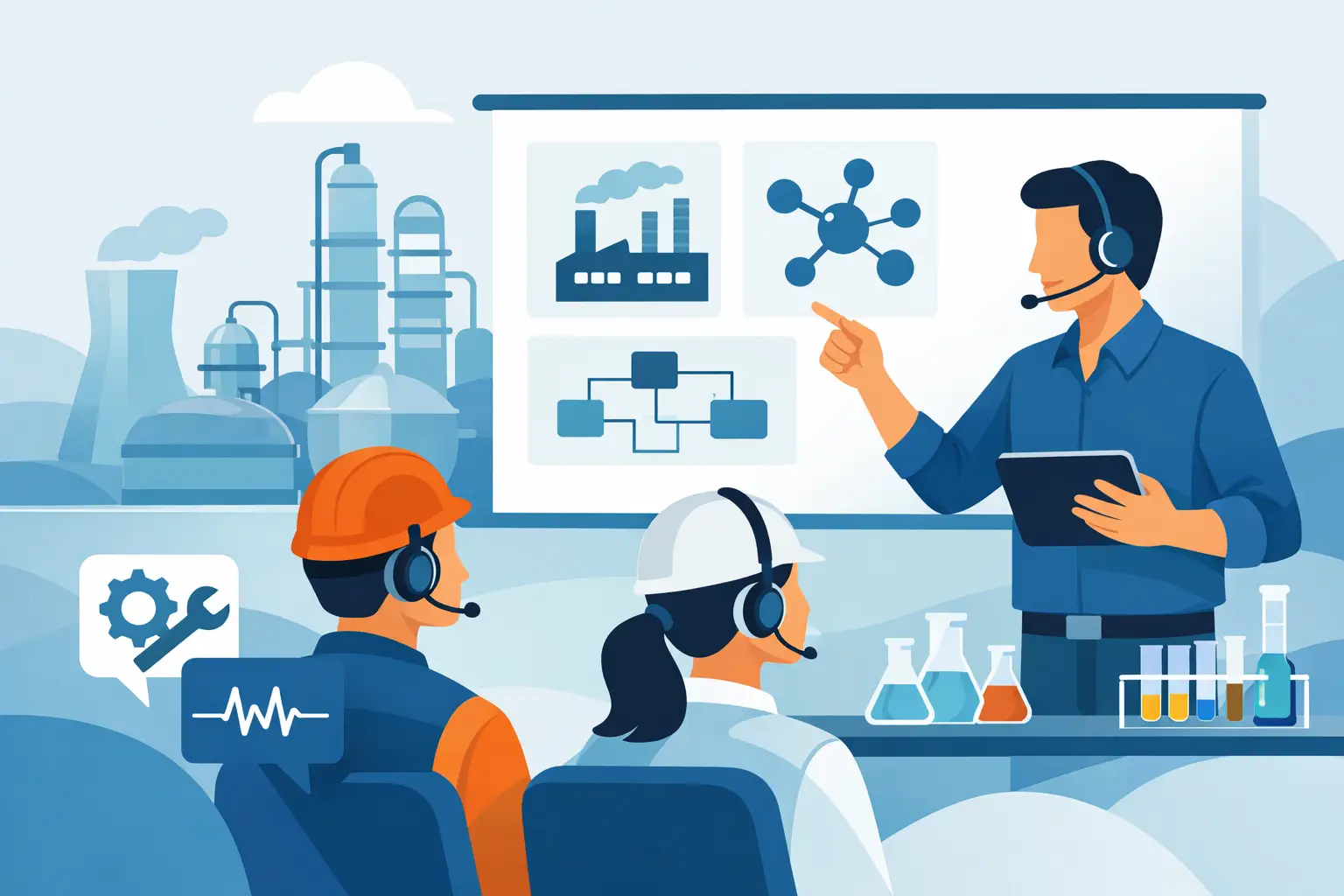
A valve isolation drill goes wrong far more easily than most training plans admit. One instructor says the line must be depressurised before the next step. The trainee hears that pressure should be reduced, not fully released. In a chemical environment, that gap is not a language issue in the casual sense. It is an operational risk. That is why a technical interpreter for chemical plant training should be treated as part of the training system itself, not as an optional extra.
Chemical plants do not run on approximate meaning. Training covers hazardous substances, lockout-tagout procedures, confined space entry, permit-to-work rules, alarm responses, sampling routines, maintenance tasks and start-up or shutdown sequences. If the interpretation is vague, simplified or technically wrong, the business does not merely lose clarity. It risks non-compliance, retraining, equipment damage, downtime and preventable incidents.
Why chemical plant training needs technical interpretation
Plant training is different from a standard multilingual meeting. The stakes are higher, the terminology is denser and the pace can shift quickly from classroom explanation to live operational context. Trainers may move from P&IDs to field equipment, from process theory to emergency procedures, within the same session. A general interpreter may follow the grammar of the conversation while missing the engineering meaning.
That distinction matters. In chemical processing, small differences in wording carry large consequences. There is a meaningful difference between venting and purging, between toxic and corrosive exposure, between interlock override and routine reset. If these terms are handled loosely, trainees may leave with confidence but without understanding. That is often the most dangerous outcome.
A qualified technical interpreter for chemical plant training does more than convert words from one language into another. They maintain the integrity of process terminology, safety instructions and operator intent. They also recognise when a trainer is using site-specific language that requires clarification before it reaches the audience.
Where errors usually happen during plant training
Training problems rarely begin with dramatic misunderstandings. More often, they start with terminology that sounds close enough. A trainer refers to an isolation point, but the interpreted version suggests a broader shutdown step. A maintenance instruction is rendered as advice rather than a mandatory action. A warning about incompatible substances becomes a generic note about careful handling.
These are not theoretical issues. They appear during induction training for new operators, contractor onboarding, commissioning support, refresher sessions for maintenance teams and EHS briefings before high-risk work. They also surface when overseas equipment suppliers train local staff on newly installed systems. Supplier terminology, plant terminology and translated documentation do not always align. Someone has to bridge those differences accurately, in real time.
There is also the human factor. Trainees in technical environments are often reluctant to interrupt. If they believe they have understood enough to proceed, they may not challenge an ambiguous phrase. This is especially common in mixed groups where senior engineers, operators and subcontractors are trained together. A capable interpreter helps prevent silent misunderstanding from travelling into live operation.
What a technical interpreter for chemical plant training actually does
The role is wider than many buyers expect. During preparation, the interpreter studies the plant context, the training agenda, expected terminology, abbreviations and any available materials. That may include process descriptions, safety manuals, operating procedures, equipment lists and presentation slides. Preparation is not administrative overhead. It is where technical accuracy starts.
During delivery, the interpreter must track complex explanations without stripping out the detail that makes them usable. If an instructor explains the reason behind a pressure limit, a dosing sequence or a contamination control measure, the interpreter needs to preserve both the instruction and the logic. People follow procedures more reliably when they understand the reason behind them.
In live environments, the interpreter also has to read the setting. Chemical plant training often takes place partly in a classroom and partly on site, near operating units, noisy equipment or restricted areas. That changes how information is exchanged. Shorter phrasing may be needed, but precision cannot be sacrificed. The interpreter must handle noise, PPE limitations and the practical realities of plant movement while keeping terminology intact.
Why general language ability is not enough
Many procurement teams initially focus on language pair and availability. Those matter, but they are not enough for a chemical site. A fluent interpreter without process industry knowledge can sound polished while introducing technical distortion. That is a costly type of failure because it is not always obvious in the moment.
Industry knowledge changes the quality of interpretation in several ways. It helps the interpreter distinguish between similar terms, anticipate likely points of confusion and recognise when a speaker has skipped a critical technical assumption. It also allows them to maintain consistency across repeated sessions, which is essential when different teams are trained over days or weeks.
There is a commercial issue here as well. If training has to be repeated because the first session was not properly understood, the loss is not limited to interpreter fees. You may be paying again for trainer time, production interruption, contractor attendance and delayed readiness. In commissioning or turnaround periods, that cost can escalate quickly.
Choosing the right technical interpreter for chemical plant training
The right choice depends on the training context. A process safety workshop requires a different depth of terminology from a basic site induction, although both still demand technical competence. If the session involves DCS operation, instrumentation, hazardous area classification or chemical handling protocols, the interpreter must be comfortable in that vocabulary before the training starts.
Ask direct questions. Has the interpreter worked in petrochemical or process plant environments? Can they support both classroom and on-site training? Are they familiar with operating procedures, maintenance language and EHS terminology? Do they prepare from client materials in advance? If the answer to these questions is vague, that should be a warning sign.
It is also worth considering continuity. Using the same interpreter across multiple sessions often improves outcomes because terminology stays consistent and the interpreter learns the plant’s preferred wording. That consistency becomes even more valuable during construction, commissioning and operational ramp-up, when training content evolves quickly and several stakeholders are involved.
The business case: risk reduction, speed and compliance
Technical interpreting is sometimes treated as a line item to minimise. In chemical plant training, that is the wrong lens. The better question is what inaccurate interpretation could cost. One incorrect safety instruction can stop a job, trigger an incident investigation or compromise audit readiness. One misunderstood operating procedure can lead to off-spec production, avoidable waste or equipment stress.
Good interpretation also improves training efficiency. Sessions move faster when participants receive clear, technically correct information the first time. Trainers spend less time repeating themselves. Questions become sharper. Competence checks are more meaningful because they test actual understanding rather than partial translation.
For businesses operating across borders or bringing in foreign specialists to train local teams in Hungary, this is not merely about convenience. It is about controlling execution risk. A specialist provider such as BeneDictum Kft. is valuable precisely because technical interpreting in these environments is not a generic language service. It is a safeguard for plant performance, workforce safety and project continuity.
When to bring an interpreter in
If multilingual staff will be trained on hazardous processes, bring the interpreter in from the planning stage, not the night before the session. The earlier the interpreter sees the materials, the better the terminology alignment will be. This is especially important for new unit start-ups, technology transfers, supplier-led equipment training and any programme linked to compliance or certification.
There are cases where lighter support may be enough. A simple plant visit for non-technical guests does not require the same depth as operator certification training. But once the session includes procedures, controls, hazards or equipment-specific instruction, technical interpreting should be treated as essential infrastructure.
Chemical plants are unforgiving places for guesswork. Training only works when the message received is the message intended. If your site is relying on multilingual communication, accuracy is not a nice-to-have. It is part of how safe, competent operation is built from day one.
0 Comments