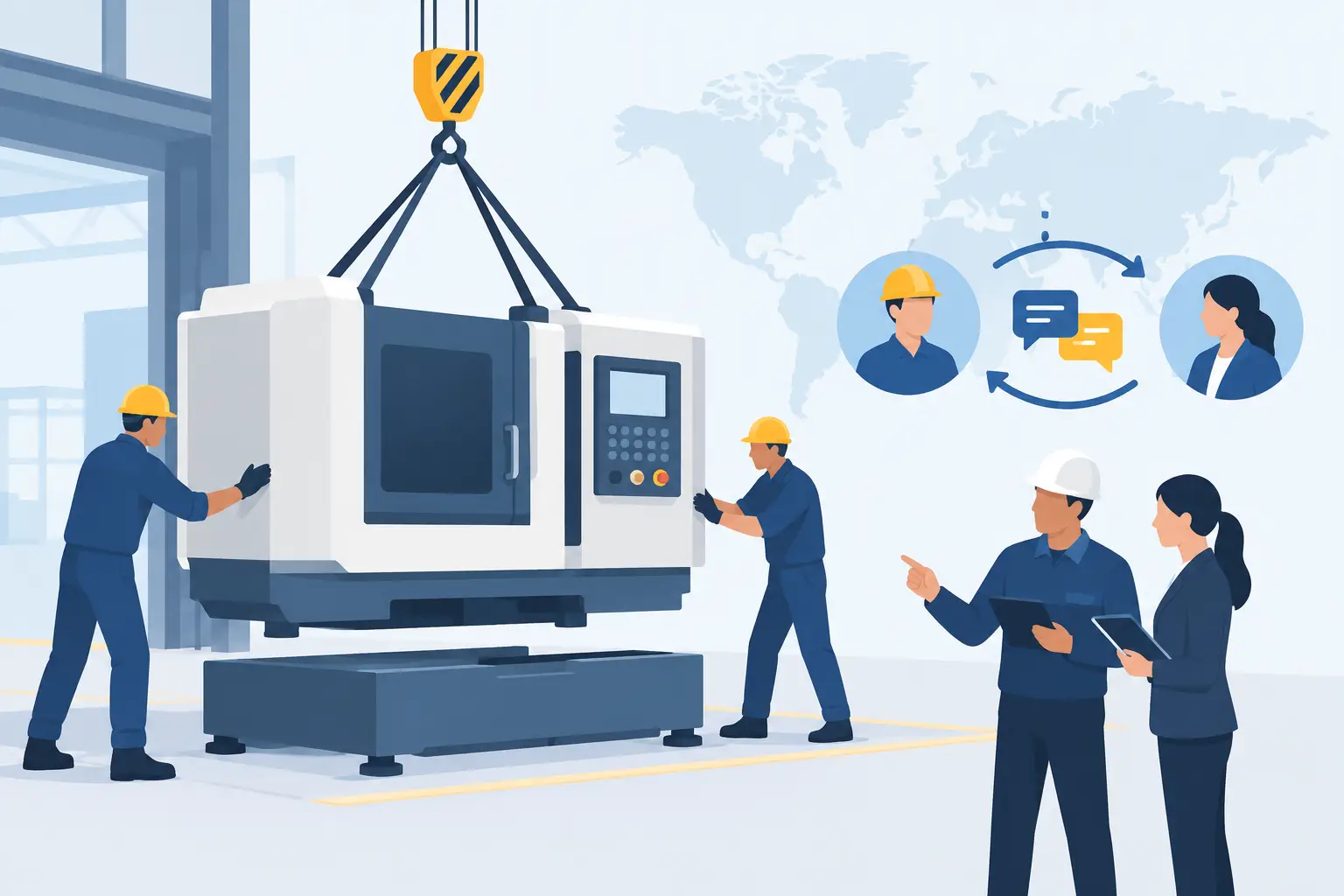
A machinery installation translation example is rarely just a language exercise. It may sit between a commissioning team and a moving production line, between an EHS procedure and a serious incident, or between a planned handover date and weeks of expensive rework. When installation instructions cross German, English and Hungarian teams, each technical term must lead to the same safe action on site.
A generic translation can look polished while changing the operational meaning of an instruction. That is the danger. The project team may understand every individual word, yet still tighten a component in the wrong sequence, remove a safeguard too soon or record an acceptance step incorrectly. For industrial investors, plant managers and project leaders, technical translation is a control against avoidable delay and exposure.
Why machinery installation language carries operational risk
Installation documentation contains far more than descriptive product information. It defines the conditions under which equipment may be unloaded, levelled, connected, tested and released for production. A phrase concerning foundation grouting can affect alignment. A mistranslated torque instruction can affect mechanical integrity. An ambiguous reference to an interlock can expose personnel during a test run.
The risk increases when several documents are used at once: OEM manuals, electrical drawings, lifting plans, supplier emails, risk assessments, work permits and commissioning records. Each may use slightly different language for the same part or process. If the translated installation manual calls a component a „cover”, while the safety procedure refers to it as a „guard”, the team may fail to recognise that a mandatory protective device is being discussed.
This is why terminology must be managed in context. The translator needs to know whether a word refers to a temporary transport restraint, a permanent machine guard, a coupling, a drive unit or a process safety device. General language ability alone does not establish that distinction.
Machinery installation translation example: three sentences, real consequences
Consider a German instruction issued for a newly installed production machine:
> Vor dem ersten Probelauf sind die Transportsicherungen an der Antriebseinheit zu entfernen. Nach dem endgültigen Verguss ist die Ausrichtung der Kupplung erneut zu prüfen. Schutzhauben erst nach schriftlicher Freigabe montieren.
A technically sound English translation would read:
> Before the first test run, remove the transport locking devices from the drive unit. After final grouting, check the coupling alignment again. Fit protective guards only after written authorisation.
At first sight, this is a short and uncomplicated passage. In practice, each sentence controls a different installation activity.
Transport locking devices are not safety devices
„Transportsicherungen” can be translated loosely as transport safety devices, but that wording is risky. It may suggest a device that should remain in place for personnel protection. In this setting, the intended meaning is a locking device fitted to prevent movement or damage during transport. Leaving it in place for a test run could damage the drive unit. Removing a genuine safety device because it has been described too broadly would be worse.
The translation must preserve both function and timing: the devices are removed before the first test run, not during unpacking and not after commissioning.
Grouting and alignment are linked, but not interchangeable
„Verguss” is often rendered as pouring, filling or casting by a non-specialist translator. In machinery installation, it commonly refers to grouting beneath a machine base or foundation. That activity can affect the final position of the equipment. The instruction therefore requires a further alignment check after grouting.
If „Ausrichtung” is translated simply as orientation, the installation team may read it as a visual positioning task. Here, coupling alignment is the precise technical requirement. Misalignment can create vibration, excessive bearing loads, seal failure and unplanned downtime shortly after start-up.
Written authorisation establishes control of the next step
„Schutzhauben” means protective guards in this context, not decorative covers or shipping covers. The phrase „erst nach schriftlicher Freigabe” also matters. It does not merely advise the team to wait. It requires documented approval before guards are fitted.
That may seem counterintuitive, since guards are normally installed as early as possible. Yet a machine supplier may require access for inspection, alignment verification or a witnessed acceptance step before final guard installation. A translator must not improve, simplify or reinterpret the instruction. The source document controls the sequence, and the target text must reflect it faithfully.
What a dependable translation process looks like
The strongest result begins before the first sentence is translated. The translator needs the document’s purpose, the equipment type, the intended reader and the current project stage. A maintenance manual and a pre-commissioning method statement may describe the same motor assembly, but they serve different decisions and require different wording.
Build terminology from the actual project documents
A project glossary should be agreed using equipment drawings, bills of materials, existing client terminology and OEM references. It should state approved equivalents for critical items such as machine guards, interlocks, earthing points, emergency stops, lockout points, lifting lugs and coupling types.
This is particularly valuable on multinational projects in Hungary, where a German supplier may issue source documentation, an English-speaking project team may manage the schedule, and Hungarian installation personnel may execute the work. Consistent terms prevent costly clarification calls at the point where work should already be progressing.
Translate instructions, values and conditions together
Technical accuracy is not limited to nouns. The translation must preserve requirements, permissions, prohibitions and conditional sequences. „Must”, „may”, „only after” and „before” can carry more operational weight than a component name.
Measurements need equally close attention. Decimal separators, units, torque values, tolerances, pressure ratings and electrical designations must be checked against the source, the drawing revision and the target-market convention. A value can be linguistically correct and still be dangerous if a unit is dropped, a decimal point is altered or a reference dimension is attached to the wrong component.
Review against the physical workflow
A final review should ask a practical question: could a competent technician carry out this step safely using the translated text? That does not mean the translator assumes the role of an engineer or changes the technical instruction. It means checking that references are traceable, warnings are visible, terminology is consistent and the sequence can be understood without guesswork.
For high-risk material, review should also compare the text with the latest drawings and revision status. Translating an obsolete machine layout perfectly still creates a site problem.
Translation alone is not enough during live installation
Written translation supports preparation, permits, manuals and acceptance records. It cannot replace a specialist interpreter when an OEM engineer is explaining an unexpected alignment issue beside an open machine, or when a safety meeting changes the agreed method of work.
Live technical interpreting is particularly valuable during equipment delivery, installation supervision, pre-commissioning, factory acceptance, site acceptance, operator training and fault-finding. The interpreter must recognise when a spoken instruction refers to a document term, a drawing callout or a component visible on the machine. Otherwise, the written and spoken messages drift apart.
For example, if an engineer says that a guard may be fitted „after release”, the interpreter needs to establish whether this refers to formal written authorisation, release of a work permit, or release of the equipment from quality inspection. Guessing is not acceptable. A qualified technical interpreter asks for clarification before uncertainty becomes an action on the shop floor.
Translate what controls risk, not merely what is convenient
Budgets and deadlines sometimes make full-document translation impractical. The answer is not to translate random pages or rely on automatic output for the rest. Prioritise documents that control safety, installation quality and handover: lifting and unloading instructions, foundation requirements, electrical connection schedules, lockout procedures, commissioning sequences, alarms, warnings and acceptance records.
Lower-risk material can be phased, provided the project team clearly knows what has and has not been approved for use. This approach balances cost against exposure without treating the machinery manual as a marketing brochure. Where an instruction determines whether equipment can be energised, moved or operated, it deserves specialist review.
BeneDictum assigns technical language specialists by industrial field, helping project teams keep terminology stable from the first installation document through to on-site communication.
Before the machinery reaches site, ask one direct question: can every person involved explain the critical instructions in the same terms and carry them out in the same order? If the answer is uncertain, resolve the language risk while there is still time to prevent it becoming an operational one.
0 Comments