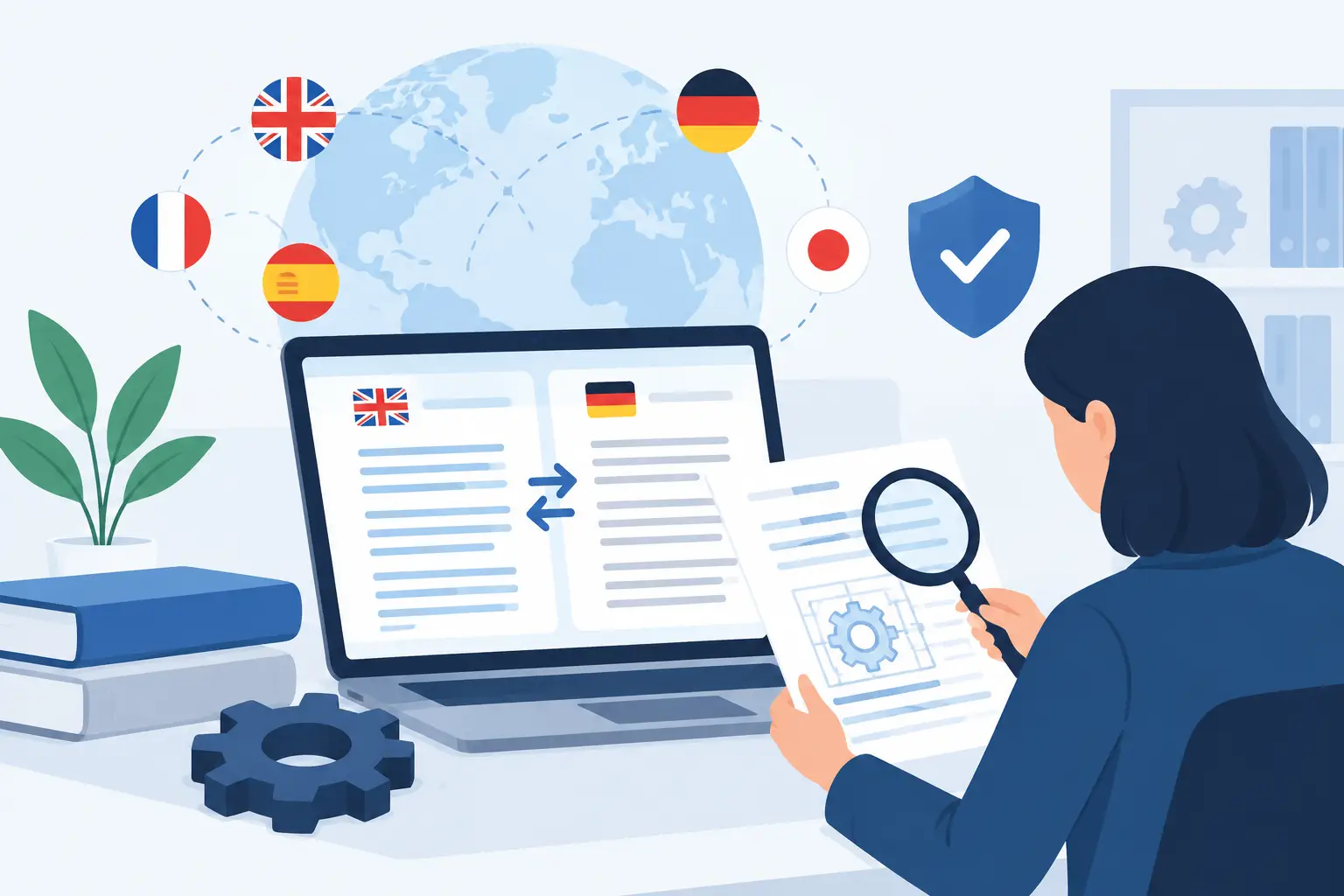
A single mistranslated instruction can stop a commissioning programme, invalidate a safety briefing or send a maintenance team to the wrong component. In industrial settings, a translation accuracy review is not a final administrative check. It is a control point that protects people, equipment, schedules and investment.
A manual may be linguistically polished yet still be operationally wrong. If a translator confuses a pressure relief valve with a shut-off valve, or renders an SAP status field inconsistently across training materials, the problem will not be solved by good grammar. It will appear on the factory floor, during start-up or in the middle of an audit.
What a translation accuracy review must verify
Technical translation quality has several layers. Spelling, punctuation and readable sentence structure matter, but they are only the starting point. A useful review tests whether the translated document communicates the same technical meaning, instruction and level of urgency as the source.
For industrial projects, the review should examine terminology, context, consistency and usability. Terminology must match the language used by engineers, operators, maintenance teams and EHS personnel. Context determines whether a term means a process, a component, a software function or a safety action. Consistency ensures that one critical item is not called by three different names across drawings, procedures and training slides. Usability asks a practical question: can the intended reader act correctly from this text under real working conditions?
This distinction matters when documents move between English, German and Hungarian. A word-for-word translation may look faithful while missing the approved plant vocabulary or the intended process sequence. The result is ambiguity at precisely the moment when employees need certainty.
Why general proofreading is not enough
Proofreading detects surface errors. It can identify a missing word, awkward phrase or typographical mistake. It cannot reliably establish whether a technical term is correct for a particular production line, power plant system or petrochemical process.
Consider a lockout-tagout procedure prepared for contractor training. The reviewer needs more than language skills. They need to understand that isolation, de-energisation, residual energy and verification are related but separate controls. If these concepts are blurred, workers may believe equipment is safe when it is not.
The same applies to automotive manufacturing instructions. A translated work instruction may describe torque values accurately, but an incorrect reference to the fastening sequence can cause rework, quality failures or delayed release. In a plant construction project, a mistranslated instruction on cable routing or earthing can create expensive corrective work after installation.
A translation accuracy review should therefore be performed by a reviewer who understands the language pair and the technical field. For high-risk documents, the reviewer should also have access to project terminology, reference documents and a person who can resolve engineering questions quickly.
The documents that need the closest scrutiny
Not every text carries the same level of operational risk. A supplier presentation can usually tolerate a minor stylistic variation. A procedure that directs work on live equipment cannot. Review effort should follow the possible consequences of error.
The highest-priority materials commonly include safety procedures, operating instructions, maintenance manuals, emergency response documentation, permits, risk assessments, commissioning checklists and contractor induction materials. Technical specifications, inspection reports and quality documentation also require close review when they determine acceptance criteria or contractual responsibility.
SAP implementation materials deserve particular attention. Training guides, system labels and process descriptions often combine specialist software terminology with site-specific workflows. If key fields, transaction steps or approval statuses are translated inconsistently, users can enter incorrect data or bypass a required control. That creates disruption long after the training session has ended.
For investment projects, translated meeting records and site-visit documentation may appear less critical than engineering drawings. Yet a vague decision log can still cause major cost exposure. If a change request, delivery condition or responsibility is misunderstood across languages, the dispute may emerge only when deadlines and penalties are already in play.
A practical translation accuracy review process
The review process should be proportionate to the document’s risk, purpose and audience. A short equipment label does not need the same treatment as a 200-page operating manual, but both need a clear owner and a defined approval route.
A reliable process usually follows four connected stages:
- Set the reference point. Provide the latest source document, approved terminology, drawings where relevant and any previous validated translations. A reviewer cannot confirm accuracy against outdated or incomplete source material.
- Check technical meaning in context. Review terminology, units, warnings, process steps, component names, software labels and abbreviations against the relevant discipline and application.
- Test consistency across the project. Compare repeated terms across manuals, slides, forms, signage and digital systems. Inconsistent vocabulary is a common source of training and handover failures.
- Resolve and record decisions. Questions should go to a named technical contact, and approved answers should be added to a project glossary. This prevents the same issue returning in the next document.
The final stage is frequently overlooked. A review that identifies errors but does not capture approved terminology only fixes one file. A maintained glossary turns each clarification into a control that supports every subsequent translation and interpreting assignment.
What reviewers should check beyond words
Numbers, formatting and document layout can change technical meaning. Decimal separators are a familiar risk in international engineering documentation. A value written as 1,5 in one convention may be read very differently by a reader expecting a decimal point. Units, tolerances, temperature ranges and torque values require deliberate checking, not assumptions.
Warnings need equal care. The difference between “may”, “must”, “do not” and “only” can alter the strength of an instruction. Safety symbols, warning headings and cross-references must remain visible and correctly linked after translation. If a translated table wraps badly and separates a warning from its related action, the layout has become an accuracy issue.
Reviewers should also test abbreviations. Some acronyms are universal within a discipline; others are site-specific or mean different things in different sectors. Expanding an abbreviation incorrectly can mislead a new contractor even when the rest of the document is sound.
When machine translation creates additional risk
Machine translation can assist with low-risk internal material, terminology searches or early drafting. It can also speed up large volumes of repetitive text when controlled by experienced linguists. It is not, however, a substitute for technical judgement.
The risk increases when source text is poorly written, terminology is proprietary, sentences depend on diagrams or a phrase has several possible meanings. Machine output may produce natural-sounding language that is technically false. This is especially dangerous because the error can be harder to spot than an obvious grammatical mistake.
Where machine translation is used, it should sit inside a managed workflow: approved source content, controlled terminology, human technical post-editing and a documented translation accuracy review. For safety-critical, contractual or commissioning documents, direct specialist translation and independent review are often the more defensible choice.
Choosing the right reviewer for the assignment
The correct reviewer depends on the subject matter. An energy project needs a different linguistic and technical profile from an automotive line upgrade or a petrochemical turnaround. General fluency alone does not demonstrate that a reviewer can distinguish between process terminology, equipment terminology and local operating language.
Ask practical questions before approving a provider. Has the reviewer handled comparable documentation? Can they work from approved glossaries and create one where none exists? How are technical queries managed? Is there a second pair of specialist eyes for high-consequence material? Can the same terminology be carried into on-site interpreting, workforce training and operational meetings?
This continuity has commercial value. When written translations and spoken interpretation use the same validated language, site teams receive one clear message. BeneDictum Kft. applies this discipline by assigning technical language specialists according to the industrial field and project requirements, rather than treating every assignment as a general language task.
Make accuracy part of project control
A translation accuracy review is most effective before documents reach the workforce, not after an incident, failed audit or delayed start-up exposes a misunderstanding. Build review time into the project plan, identify technical approvers early and treat terminology decisions as controlled project data.
When the instruction has to work beside machinery, in a control room or during a high-pressure handover, the real test is simple: will every person understand exactly what must happen next? That is the standard worth funding.
0 Comments