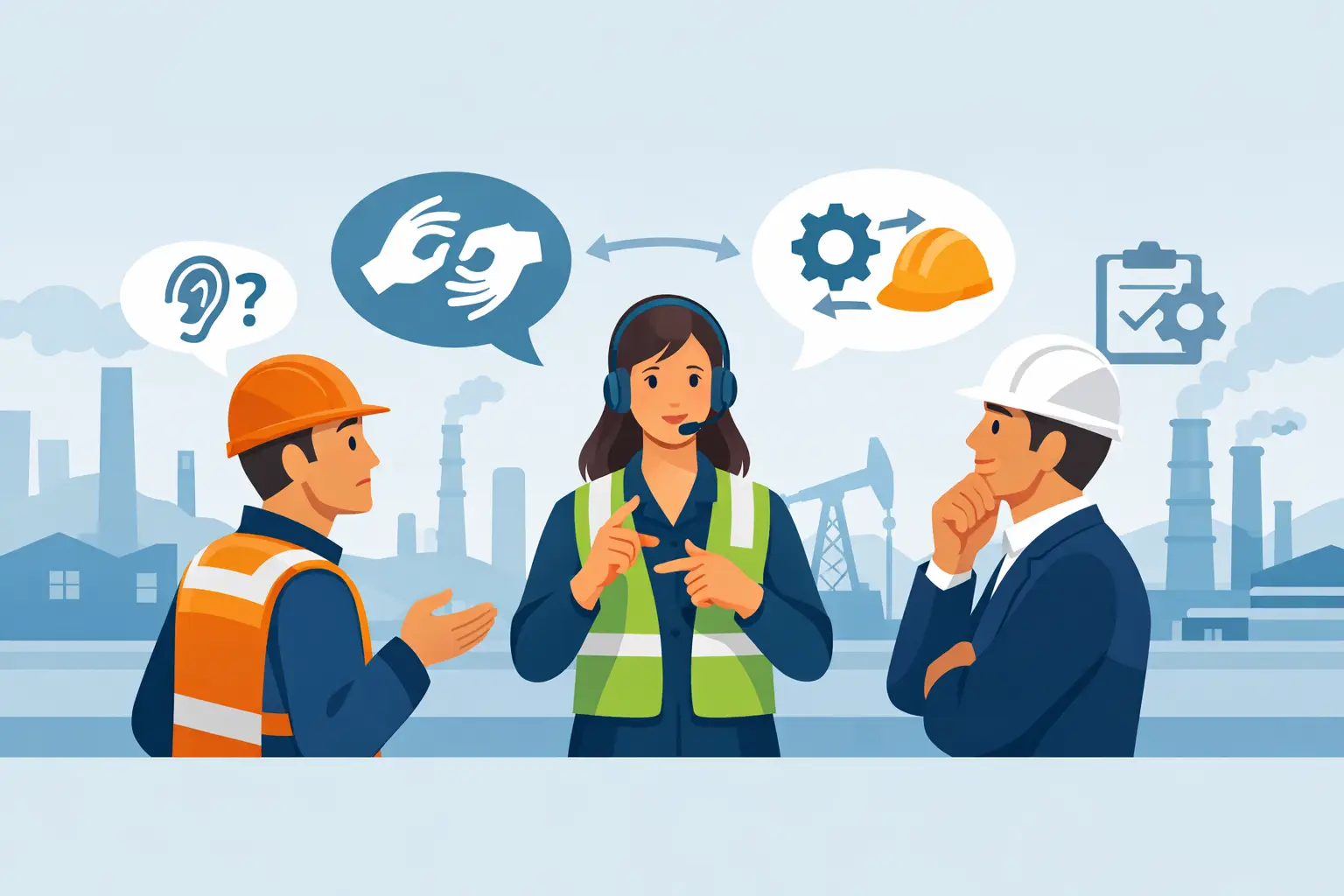
A permit-to-work briefing is not the moment to hope everyone has understood the wording. When contractors, engineers, supervisors and visiting specialists are working across languages, an industrial safety interpreter becomes part of the risk control process itself. In heavy industry, one mistranslated warning, one vague instruction or one misunderstood lockout step can stop production, fail an audit or put people in direct danger.
This is why industrial safety interpreting should never be treated as a simple language service. On a live site, the interpreter is supporting comprehension where the cost of ambiguity is unusually high. That applies whether the setting is a factory extension, a power plant shutdown, a petrochemical turnaround, a machinery installation or a multilingual workforce training session.
What an industrial safety interpreter actually does
An industrial safety interpreter transfers meaning accurately in situations where safety rules, operating procedures and technical instructions must be understood first time. That sounds straightforward until you look at the vocabulary involved. The work often includes isolation procedures, confined space rules, hot work controls, emergency response actions, machinery guarding, chemical handling, lifting operations and contractor induction content.
In those environments, language is tied to action. If a supervisor says a line must be depressurised before maintenance begins, the interpreter cannot soften, shorten or generalise that instruction. If an EHS manager explains the difference between a site hazard and a task-specific risk, that distinction matters. If a trainer is covering near-miss reporting or evacuation routes, every term has operational consequences.
A capable interpreter in this field also needs to understand how industrial communication works on site. Safety briefings are fast. Speakers may switch between technical terminology and plain spoken instructions. Background noise, PPE, multiple accents and time pressure all make the assignment harder. General language ability is not enough.
Why general interpreting is often not enough
Many procurement teams first look for language coverage, then assume any experienced interpreter can manage the safety side. That assumption is where avoidable risk begins.
Industrial sites do not reward approximation. A general interpreter may be fluent in both languages yet still miss the practical difference between commissioning and start-up, between earthing and bonding, or between a warning sign and an instruction sign. In safety communication, these are not academic details. They affect behaviour, compliance and accountability.
There is also the issue of confidence. On complex sites, people often speak in shorthand. Engineers refer to systems by acronym. Safety officers assume familiarity with permit categories and plant-specific rules. Contractors may ask blunt, fragmented questions under time pressure. An interpreter without industrial context can become hesitant at exactly the wrong moment, and hesitation slows the whole exchange.
That does not mean every assignment needs the same level of specialisation. A routine plant visit may be less exposed than a high-risk shutdown briefing. But once work involves hazardous processes, technical training, live operational communication or regulated safety procedures, specialist knowledge stops being optional.
Where the business risk shows up
The clearest reason to appoint an industrial safety interpreter is to reduce the chance of accidents. But safety is not the only exposure.
A poor interpretation in an induction can lead to repeat explanations, delayed access and confusion over site rules. In a training session, it can mean operators leave the room without fully understanding safe operating limits or escalation procedures. During installation or commissioning, it can create errors that need rework, pushing back deadlines and increasing contractor costs.
Then there is the audit and compliance angle. If external specialists, visiting management or overseas contractors do not properly understand site controls, records and declarations may not reflect reality. That can create uncomfortable questions later, particularly after an incident or near miss.
For investors and project leads, the financial dimension is just as important. Miscommunication around safety rarely stays in the safety column. It affects productivity, access permissions, handover quality, workforce confidence and schedule discipline. A relatively small interpreting decision can protect a very large capital programme.
High-stakes situations where specialist interpreting matters most
Some assignments carry more language risk than others. Safety inductions for multilingual contractors are one obvious example, especially when large numbers of external workers need fast, accurate onboarding before entering an active site.
Workforce training is another. If machine operators, maintenance teams or temporary staff are being trained in safe procedures, the interpreter must preserve both the technical meaning and the trainer’s intended emphasis. A casual paraphrase can weaken the message.
Shutdowns and turnarounds are particularly demanding because the pace is high and the margin for error is low. The same is true for plant construction, power projects and petrochemical work, where terminology is specialised and many activities are permit-controlled.
Factory acceptance tests, site acceptance tests and commissioning meetings also deserve attention. These sessions often combine technical detail with decisions about readiness, defects, temporary controls and next steps. If safety-related objections or limitations are not interpreted precisely, teams may move forward with different assumptions.
Even office-based settings can carry risk. SAP implementation workshops, operational meetings and EHS reviews may not involve hard hats and exclusion zones, but they can still shape how procedures are recorded, assigned and followed later on site.
What to look for in an industrial safety interpreter
The right choice starts with sector knowledge. An interpreter who understands energy, petrochemicals or automotive manufacturing will usually be better placed to follow plant terminology, process language and the practical logic behind safety rules.
Preparation also matters. The best interpreters ask for site materials in advance – inductions, procedures, risk documentation, technical glossaries and meeting agendas where available. That preparation reduces avoidable uncertainty and improves consistency across repeated sessions.
You should also look at how the interpreter handles pressure. Industrial communication is rarely tidy. Speakers interrupt each other. Conditions are noisy. Site walks move quickly. Questions come without warning. A dependable interpreter stays accurate without losing control of the exchange.
Certification and professional discipline are part of the picture too, although credentials alone are not enough. What matters commercially is whether the interpreter can support clear, accurate decision-making in real industrial conditions.
The operational value of getting it right first time
A strong industrial safety interpreter does more than translate words. They help keep meetings efficient, training credible and site communication aligned. When instructions are understood immediately, teams spend less time repeating themselves and less time correcting preventable mistakes.
That efficiency is easy to underestimate. Project managers often see the value first when multilingual meetings begin to move at the right pace. EHS leads notice it when safety sessions produce fewer confused follow-up questions. Plant managers notice it when external teams integrate more quickly and operational disruption is lower.
There is also a trust factor. Workers are more likely to follow procedures properly when explanations are clear and delivered in language they fully understand. Overseas specialists are more likely to contribute useful observations when they are confident nothing material is being lost in translation. Better communication improves both safety culture and execution.
For that reason, specialist interpreting should be planned early, not booked as an afterthought. If the assignment involves hazardous work, technical systems or regulated procedures, language support belongs in the project plan alongside other controls.
Industrial safety interpreter support is not one-size-fits-all
The exact brief depends on the site, the workforce and the task. Some clients need support for a one-day induction. Others need an interpreter across several weeks of installation, training and commissioning. Some require English-Hungarian coverage, others German-Hungarian, and larger projects may involve multiple language interfaces at once.
The working method can vary as well. Consecutive interpreting may suit toolbox talks, audits and training sessions where clarity matters more than speed. Liaison-style support may work better during site walks, inspections and practical demonstrations. For conferences or large formal events, simultaneous interpreting may be appropriate, but only if the technical content and setting justify it.
That is why experienced providers match the interpreter to the assignment rather than sending the next available linguist. BeneDictum Kft. approaches technical interpreting in exactly that way: as a risk-sensitive industrial service where terminology knowledge and sector fit directly affect results.
If people on your site are expected to work safely, answer correctly, sign confidently and act without hesitation, they need more than a bilingual presence. They need someone who can carry critical meaning across languages without dilution. In industrial environments, that is not an extra. It is part of how serious organisations protect people, time and money.
0 Comments