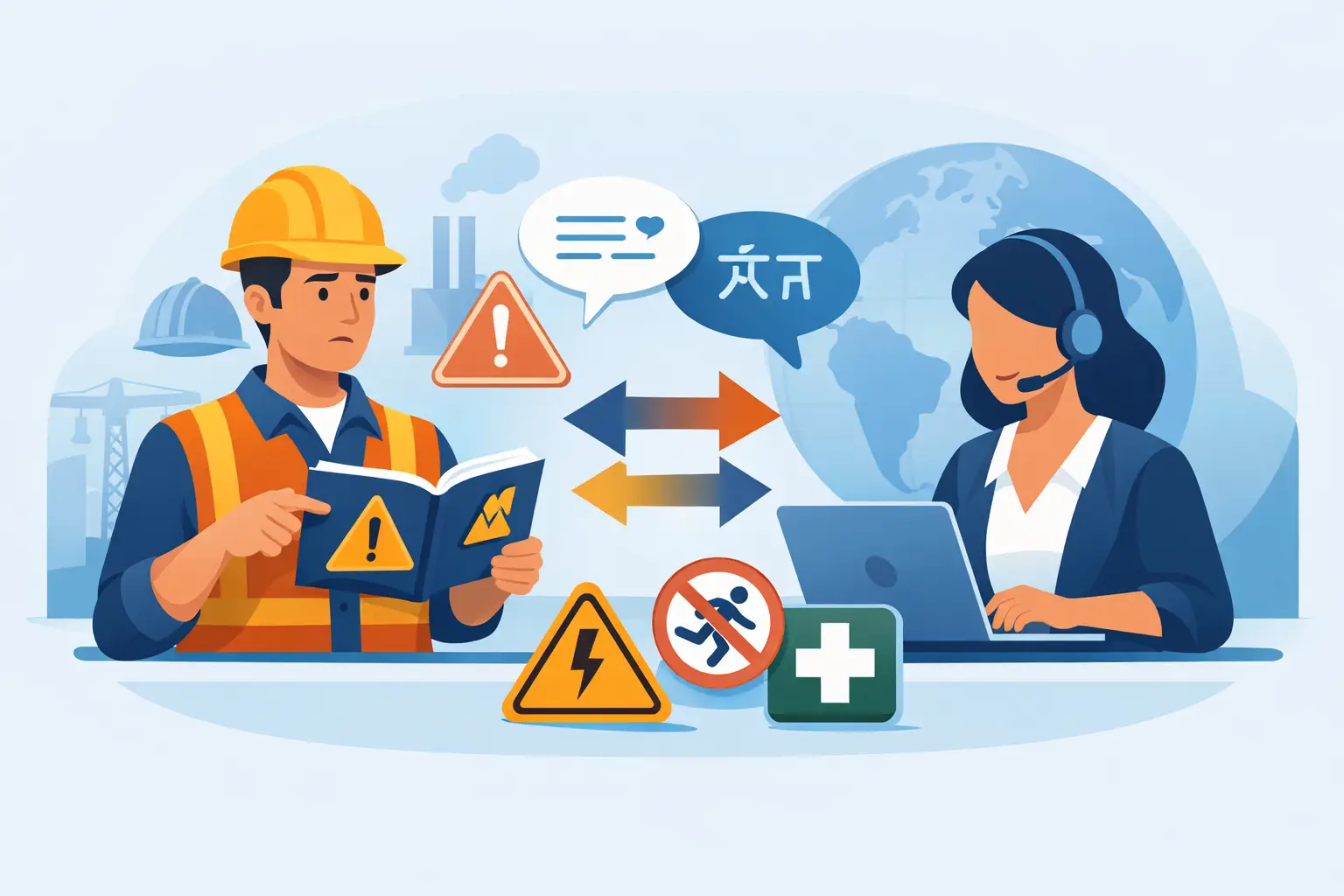
A permit-to-work briefing goes wrong faster than most managers expect. One supervisor says a line is isolated, another hears that it is ready for testing, and a contractor steps into a live-risk area with the wrong understanding of the controls in place. That is where safety terminology translation stops being a language task and becomes an operational safeguard.
In industrial environments, the margin for misunderstanding is narrow. A mistranslated warning, an imprecise toolbox talk or a poorly interpreted lockout instruction can lead to injury, downtime, failed audits and expensive rework. For plant managers, EHS leaders and project teams, the issue is not whether people broadly understand one another. The issue is whether every critical term means exactly the same thing to every person on site.
What safety terminology translation really covers
Many buyers think first about documents such as risk assessments, operating procedures and induction materials. Those matter, but the real scope is wider. Safety terminology translation covers the language used in written instructions, live interpreting, equipment labels, compliance documentation, emergency procedures, training sessions and site coordination meetings.
That includes terms that look simple but carry very specific operational meaning. Isolation is not the same as shutdown. Venting is not the same as depressurisation. Supervision is not the same as authorisation. In a factory construction project or plant turnaround, these distinctions are not academic. They affect who may enter an area, what equipment can be touched and whether a process can continue without exposing people to harm.
The challenge becomes sharper when several disciplines work together. Civil contractors, mechanical fitters, commissioning engineers, automation specialists and client-side safety staff often use the same words differently. Add multiple languages to that mix and the risk multiplies.
Why general translation is not enough
Safety language sits at the intersection of compliance, engineering and site reality. A general translator may produce text that reads well but misses the exact meaning used by operators, maintenance teams or EHS professionals. On paper, the sentence can appear correct. On site, it can still fail.
Consider the difference between a guard, an interlock and an emergency stop. All relate to protection, but they do different jobs and trigger different operator responses. The same applies to confined space terminology, hazard communication, lifting operations and chemical handling instructions. If the person translating or interpreting does not understand the process behind the term, they may choose a near equivalent that weakens the instruction.
This is where industry-specific knowledge matters. A language professional supporting a petrochemical shutdown needs a different command of terminology from one assigned to an automotive training programme or an energy infrastructure project. The language is technical, but the consequences are commercial.
The cost of getting safety terminology translation wrong
When managers assess language support, they often look first at day rates or document costs. That is understandable, but it can be a false economy. The real comparison is between the price of specialist support and the cost of a misunderstood instruction in a live industrial setting.
One common failure point is workforce training. If machine safety training is translated loosely, operators may leave the session with partial understanding and false confidence. The training is logged as complete, yet the intended control has not actually been transferred. That creates a compliance problem and a practical risk on the shop floor.
Another failure point is implementation work. During commissioning, SAP rollouts or equipment upgrades, safety-related terminology appears in meetings, change requests and handover discussions as well as in formal manuals. If live interpretation is not precise, teams make decisions on incomplete understanding. That can delay acceptance, trigger retesting and create conflict between contractor and client over what was agreed.
Then there is audit exposure. Auditors do not only review whether documents exist. They examine whether procedures are understood and applied consistently. If translated safety content is vague, inconsistent or detached from the site’s actual terminology, the weakness shows quickly.
Where precision matters most on site
Some parts of industrial communication carry more risk than others. Permit-to-work systems are high on that list because they depend on exact conditions, exact responsibilities and exact timing. If permit categories, isolations, atmospheric testing requirements or handback conditions are translated inconsistently, the control system itself becomes less reliable.
Inductions and refresher training are another pressure point. These are often treated as routine, especially on large projects with rotating contractor teams. Yet they establish the baseline for how people interpret alarms, signage, access restrictions and incident response procedures. If the wording is unclear, every later instruction becomes harder to enforce.
Emergency communication demands a different level of discipline again. In an evacuation, gas release, fire event or medical incident, there is no room for explanatory guesswork. Terminology must be pre-aligned, familiar and unambiguous. The right phrase delivered late or awkwardly is not enough.
How to judge whether your safety terminology translation is fit for purpose
The first question is simple: does the translator or interpreter understand the industrial process, not just the words around it? If they cannot distinguish between production, maintenance, commissioning and shutdown contexts, they are likely to miss the practical meaning of key terms.
The second question is whether terminology is managed consistently. A one-off translated document may appear acceptable until it conflicts with language used in a training session, a method statement or a site meeting. Consistency across spoken and written communication is what protects operations.
The third question is whether the service can handle live, high-stakes interaction. Safety communication often happens under time pressure, around noise, with mixed seniority levels and with participants who assume shared understanding when it does not exist. Interpreting in those conditions requires more than fluency.
A dependable provider will ask for site context, reference materials and the intended audience. They will want to know whether the assignment involves factory construction, plant visits, audits, commissioning or operational meetings. That is not administrative detail. It is how technical language support is matched to the real risk profile of the job.
Safety terminology translation in multilingual Hungary-based projects
Hungary-based industrial projects often involve a moving mix of local staff, foreign contractors, investors, OEM specialists and visiting auditors. English and German are common working languages, but the real challenge is not the number of languages involved. It is the number of assumptions different teams bring to the same conversation.
On a new facility build, for example, investor expectations, contractor practices and local site rules may not align neatly. The phrase safe to start can mean one thing to a commissioning lead and another to a contractor waiting for approval. In these situations, specialist interpreting and translation reduce friction as well as risk. They help ensure that approvals, warnings and obligations are understood in the same way by everyone required to act on them.
That is why companies such as BeneDictum position technical language support as risk control rather than admin support. In sectors where one wrong term can stop production or expose people to danger, the commercial value is obvious.
It depends – and that is exactly the point
Not every assignment needs the same level of intervention. A standardised document set for repeat internal use may only require terminology review and careful translation. A hazardous commissioning phase with multinational teams may need an interpreter with direct sector knowledge on site, in meetings and during training.
The right approach depends on the complexity of the process, the maturity of your terminology, the language combinations involved and the cost of misunderstanding. What should not vary is the standard for precision. If the communication affects safety, the language must be treated as part of the control system.
For decision-makers, that means asking a harder but more useful question than Do we need translation? Ask instead: where could inaccurate terminology create harm, delay or liability in this project? Once you answer that honestly, the business case becomes much clearer.
The safest sites are not the ones with the most paperwork. They are the ones where every critical instruction is understood exactly as intended, by every person who needs to act on it.
0 Comments