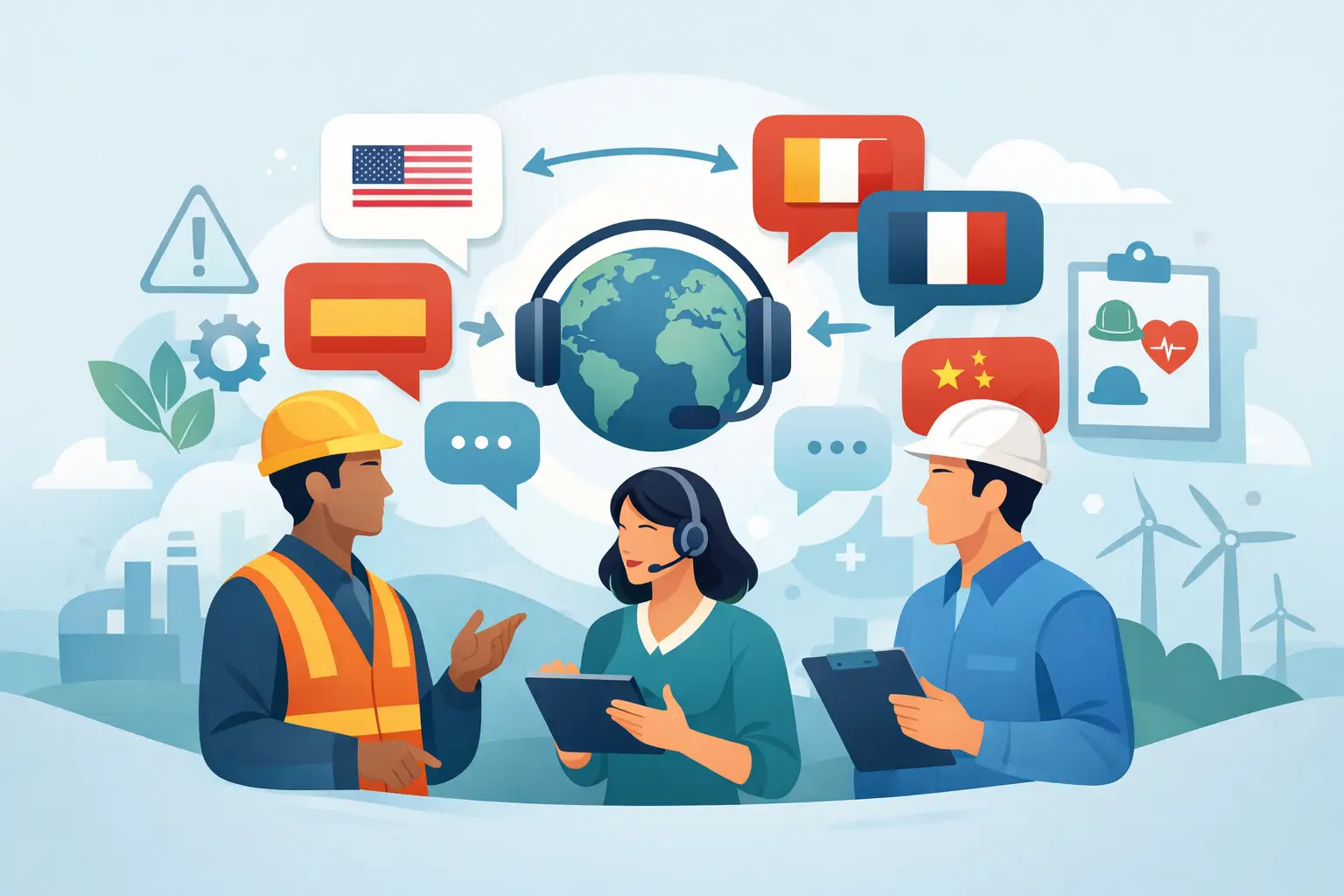
A safety briefing fails long before an incident occurs. It fails when a contractor nods without understanding a lockout procedure, when a supervisor uses a familiar word with a different technical meaning, or when a translated sign tells people what to wear but not when a task must stop. A multilingual EHS communication strategy exists to prevent those moments from reaching the production line, the construction zone or the control room.
For industrial businesses operating across borders, language is not an administrative detail. It is part of the safety control system. If instructions are unclear, training is misunderstood or an audit response is interpreted inaccurately, the result can be an injury, a shutdown, a failed inspection or a costly delay. The financial consequences can be substantial, but the human consequences come first.
Why multilingual EHS communication needs technical control
EHS communication covers environmental, health and safety information, but its practical scope is wider than policies and warning signs. It includes toolbox talks, induction sessions, permit-to-work discussions, incident investigations, emergency drills, contractor briefings, equipment handovers and meetings with regulators or visiting specialists.
Each setting has a different level of risk. Translating a general visitor notice is not the same as interpreting an instruction for isolating live equipment in a power plant. A general bilingual speaker may understand the words, yet miss the distinction between isolation, de-energisation, depressurisation and lockout. In petrochemical, energy and automotive environments, those distinctions are operationally decisive.
This is why a multilingual EHS communication strategy must account for technical terminology, site-specific procedures and the way people actually receive information under pressure. Written translation alone is rarely enough. On-site spoken communication, confirmation of understanding and consistent terminology across documents and meetings are equally necessary.
Start with the moments where misunderstanding causes harm
Do not begin by translating every document in the EHS folder. Begin with a risk-based communication review. Identify where language gaps could change behaviour, delay a decision or prevent a worker from raising a concern.
For a factory expansion, the priority may be contractor induction, lifting plans, confined-space entry and daily coordination meetings. During an SAP implementation, the concern may be whether personnel understand new workflow approvals that affect maintenance records, incident reporting or access permissions. At an operational plant, emergency response instructions, shift handovers and maintenance shutdowns may require the closest scrutiny.
Ask practical questions. Which nationalities and language groups are present on site? Who gives instructions, and who must act on them? Which terms are non-negotiable? Where do workers rely on verbal explanations rather than written material? Which activities carry the highest consequence if a phrase is misunderstood?
The answers should produce a communication risk map, not a generic language plan. It should show the critical activities, audiences, languages, documents, meetings and responsible owners. It should also distinguish between information that can be translated in advance and situations that need a qualified technical interpreter present.
Treat verbal communication as a controlled process
High-risk instructions are often delivered verbally because the work is changing. A supervisor may need to explain an altered exclusion zone, an equipment fault or a revised sequence of work immediately. In these circumstances, asking a bilingual colleague to interpret informally is a serious gamble.
A colleague may be capable and well intentioned, but they may not know the approved term, understand the full context or feel confident enough to interrupt a senior engineer when a statement is unclear. They may simplify a message to keep the meeting moving. That is precisely when critical conditions, limits and exceptions disappear.
A certified technical interpreter brings linguistic skill together with relevant field knowledge. They can follow discussions about machinery, process safety, electrical systems and maintenance work without turning every technical term into a long explanation. More importantly, they can signal ambiguity before it becomes an instruction in the wrong language.
Build one source of truth for safety terminology
Consistency is a safety measure. If one document uses “emergency shutdown”, another says “trip”, and an interpreter uses a different local expression without explaining the distinction, workers may assume these are interchangeable. They may not be.
Create an approved multilingual terminology base for your site or project. It should include equipment names, hazards, PPE, permit categories, process stages, alarm states, emergency commands and abbreviations. Add the context where needed. For example, a term used in a mechanical maintenance procedure may require a different explanation from the same word in an electrical isolation procedure.
This resource should be developed with EHS leaders, engineers, operations personnel and language specialists. It must then be used across training materials, signage, translated procedures, presentations and interpreting assignments. A glossary that sits unused in a shared folder provides no protection.
Review it whenever the site introduces new equipment, processes or contractor groups. The terminology needed for a battery production line will not mirror that required for a refinery turnaround. Standardisation matters, but it must reflect the actual work being performed.
Design training for understanding, not attendance
A signed attendance sheet proves that someone was present. It does not prove that they understood a chemical handling procedure or know what to do when an alarm sounds.
Multilingual training should use clear, controlled language supported by diagrams, photographs, demonstrations and practical scenarios. This is not a substitute for accurate interpretation. It reinforces it. When a worker hears an instruction in their strongest language, sees the relevant equipment and demonstrates the correct action, the organisation has a more credible basis for believing the training has worked.
Build checks into the session. Ask participants to explain key steps back in their own words, identify hazards in a real work area or demonstrate the correct escalation route. These checks should be respectful, not performative. Their purpose is to expose unclear communication before work begins.
For complex training – such as crane operations, energy isolation, process safety or specialist SAP workflows – plan interpreters into the programme from the outset. Sending slides for translation the night before is not preparation. The interpreter needs time to review the materials, clarify acronyms and align language with the project terminology base.
Make contractors part of the strategy
Contractors often create the greatest communication challenge because their workforce can change quickly. A site may have multiple subcontractors, different first languages and varying levels of familiarity with local rules. Assuming that a contractor’s supervisor will communicate everything accurately is not sufficient governance.
Set language requirements during procurement and mobilisation. Specify which safety documents must be available in which languages, who is responsible for briefing each team, and when technical interpreting is mandatory. Include language readiness in pre-start checks alongside insurance, qualifications, permits and PPE.
There is a trade-off. Translating every low-risk message into every possible language can slow mobilisation and create document-control problems. The answer is not less communication. It is prioritisation: translate controlled written material for recurring, high-risk content, and provide technical interpreting for live, changing or complex discussions.
Test your multilingual EHS communication strategy under pressure
The true test is not the induction room. It is the moment a fire alarm activates, a leak is suspected, a lifting operation changes or an auditor asks a precise question through several languages.
Run multilingual drills and observe where messages stall. Can workers understand evacuation instructions without relying on one bilingual person? Can a supervisor communicate a stop-work order immediately? Can foreign specialists explain a technical finding accurately to the local EHS team? Record what was misunderstood and correct the terminology, process or training material behind it.
Incident and near-miss investigations should also examine communication. If a worker did not follow a procedure, establish whether the procedure was accessible, whether the briefing was interpreted accurately and whether the worker had a safe way to ask questions. Blaming an individual without examining the communication chain leaves the same failure in place.
Use specialist support where the exposure is highest
The cost of specialist technical interpreting should be judged against the exposure it controls. A delayed commissioning meeting, a misinterpreted safety condition or a failed contractor briefing can cost far more than professional support planned at the right point.
BeneDictum provides certified technical interpreters for demanding industrial assignments in Hungary, including site construction, audits, workforce training, operational meetings and plant visits. The value is not simply that participants can speak. It is that critical technical meaning remains intact when decisions, instructions and safety obligations cross languages.
The strongest safety culture gives people the authority to stop unsafe work. A well-run multilingual communication programme gives them the language, confidence and clarity to use that authority when it matters.
0 Comments