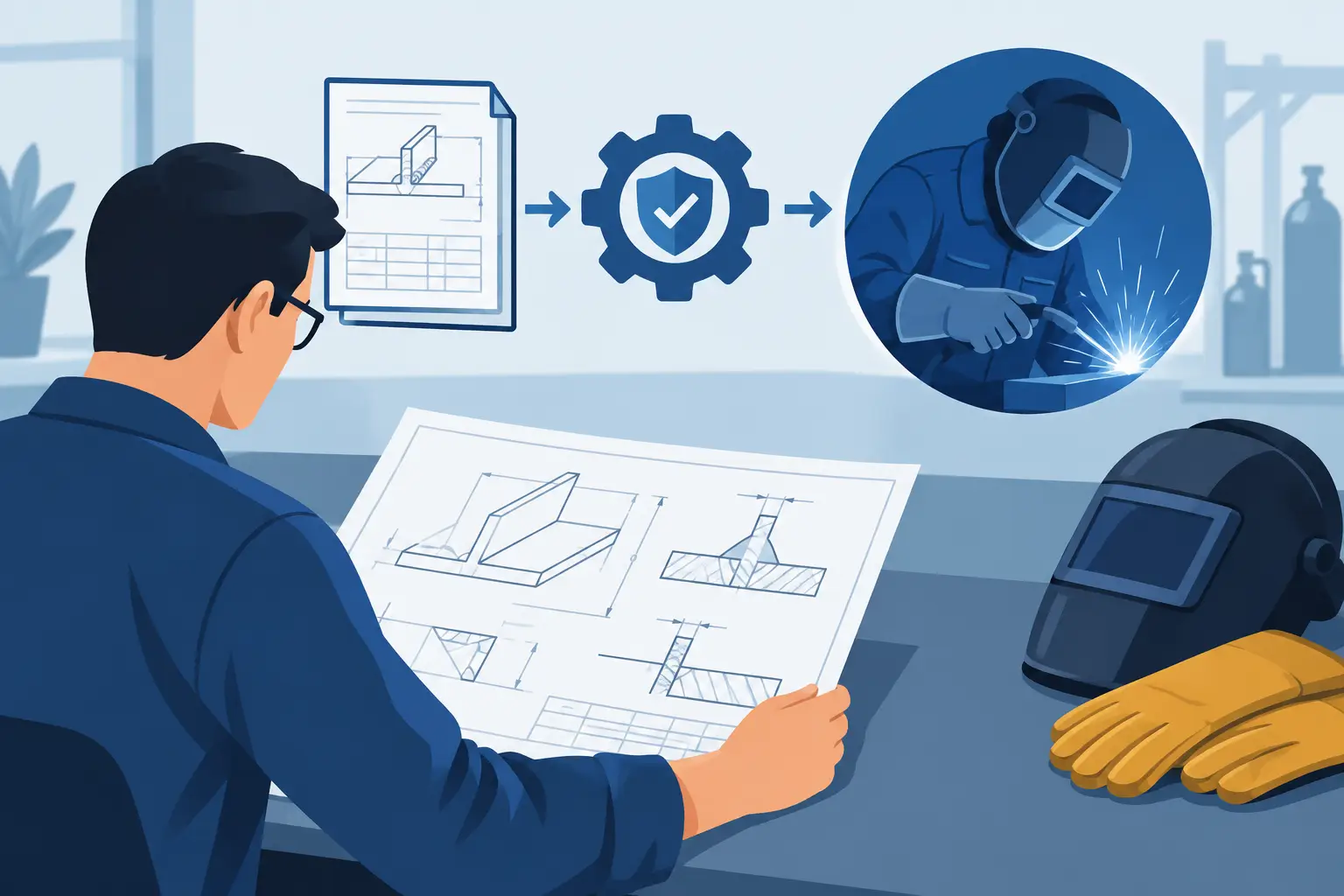
A welding specification can look like a short technical document, yet one mistranslated parameter can stop production, fail an inspection or create an unacceptable safety risk. Knowing how to translate welding specifications is therefore not simply a language task. It is a controlled technical process in which terminology, standards, drawings and site conditions must agree.
For a fabrication manager, EPC contractor or quality lead, the question is not whether a translator can render the words. The question is whether the translated document will allow the welder, welding coordinator, inspector and client representative to make the same decision from the same instruction.
Start by identifying what the document controls
“Welding specification” is often used as a catch-all term. In practice, the document may be a Welding Procedure Specification (WPS), a Procedure Qualification Record (PQR), a welder qualification record, an inspection and test plan, a weld map, a repair procedure or a client-specific fabrication requirement. Each has a different purpose, audience and legal or contractual weight.
A WPS tells the welding team how a joint is to be made. It can specify the process, parent material, filler metal, joint preparation, preheat, interpass temperature, shielding gas, position, electrical parameters and post-weld heat treatment. A PQR records the evidence that supports a qualified procedure. Translating both in the same style, without recognising their different functions, can create confusion during an audit.
Before translation begins, establish the governing document and the applicable standard. This may be ISO, EN, ASME, AWS, API or a project specification. Do not assume that a familiar English term has a direct equivalent in German, Hungarian or another project language. In welding, terms often gain their exact meaning from the code that governs the work.
How to translate welding specifications without changing requirements
The first rule is simple: translate the instruction, not the translator’s interpretation of what the instruction ought to mean. Where the source contains an ambiguity, inconsistency or missing value, it should be raised as a technical query. It must not be quietly corrected in translation.
This distinction matters on site. If a WPS lists a preheat temperature range that conflicts with a material supplier’s requirement, a translator cannot decide which figure is preferable. The discrepancy belongs with the welding engineer, responsible coordinator or client representative. The translated version should preserve the source faithfully while the query is resolved through the project’s document-control process.
At the same time, literal word-for-word translation is unsafe. Welding terminology is highly contextual. “Backing”, for example, may refer to a backing strip, backing gas, backing ring or backing weld, depending on the joint and procedure. A general translator may select a plausible term that is technically wrong. A specialist translator checks the drawing, process, material and standard before choosing the equivalent used by the target-language welding community.
Protect the data that controls weld quality
Much of the risk in welding translation sits in figures, codes and symbols rather than in long paragraphs. A translation workflow must actively protect this information.
Units require particular care. Heat input may be stated in kJ/mm, material thickness in millimetres, gas flow in litres per minute, and temperature in degrees Celsius. A converted value should not replace the original unless conversion is explicitly required by the client. Where a conversion is useful, retain the source unit and show the converted value clearly, using a verified calculation.
Decimal separators are another frequent source of error in multilingual projects. In many European documents, 1,5 mm means one and a half millimetres. In an English-language environment, 1.5 mm is more common. A document format must be consistent, and the project team must know which convention applies. A misplaced decimal point in root gap, electrode diameter or heat input is not a minor editorial issue.
Material designations also demand controlled handling. Steel grades, consumable classifications, heat-treatment cycles and approval references should normally remain exactly as specified, even where an explanatory target-language description is added. Replacing a designation with an approximate local equivalent can alter traceability and invalidate procurement or inspection records.
The same principle applies to welding symbols. Symbols should be retained graphically where possible, not recreated from memory or explained loosely in prose. Their interpretation depends on the reference line, arrow side, other side, dimensions, contour requirements and supplementary symbols. A translator should work from legible drawings and use document formats that preserve the original visual relationship between symbol and instruction.
Build the translation around the full document set
A WPS rarely stands alone. Translating it without the associated drawing, weld map, material schedule and acceptance criteria invites errors. The translator may need to verify whether “all-round weld” refers to a specific symbol, whether a joint is single-V or double-V, or whether a material abbreviation is defined elsewhere in the package.
Provide the complete controlled set wherever possible, including revision status. A perfectly translated superseded WPS is still the wrong document. For high-value work, the translation should include document number, revision, issue date and page references that match the source. This allows a welder or inspector to demonstrate exactly which instruction was used.
A bilingual terminology list is valuable when a project contains repeated materials, processes, defects or inspection terms. It should be approved by the client’s technical authority, then applied consistently across WPSs, method statements, welding logs, non-destructive testing reports and training materials. Consistency is not cosmetic. If one document calls a defect “lack of fusion” and another uses a term closer to “incomplete penetration”, the quality team may be dealing with two different discontinuities.
Use a specialist review, not a spelling check
Standard proofreading will catch typographical errors, but it cannot confirm whether a translated procedure remains technically coherent. A credible quality process includes linguistic review and technical verification against the source.
The technical reviewer should check the parameters that determine whether the procedure can be followed and inspected: welding process, base and filler materials, joint details, thickness range, position, preheat and interpass limits, electrical settings, gas, travel speed where stated, heat treatment, and acceptance standard. They should also verify that tables, notes and footnotes have not been omitted during formatting.
This is especially critical where the translation will be used during welder training or a pre-job briefing. A misunderstood verbal explanation can often be corrected in the room. A faulty translated WPS may be copied into work packs, issued across shifts and relied upon after the original engineer has left site.
Account for the people who will use the translation
The best translation depends partly on its operational purpose. A document intended for a welding engineer may preserve standard references and specialist terminology with minimal explanation. A work instruction for a multilingual shop-floor team may require controlled clarifications, labelled diagrams or a bilingual layout approved by the responsible welding coordinator.
Do not simplify away technical requirements in the name of readability. Instead, separate the controlled specification from supporting guidance. The WPS remains the authoritative instruction. A separate translated briefing sheet can explain sequence, terminology or safety expectations in language that is easier for the team to follow.
If the procedure must be discussed during qualification, repair work, a client audit or an incident review, written translation may not be enough. A technical interpreter with welding and fabrication knowledge can ensure that questions about parameters, discontinuities and acceptance limits are communicated accurately in real time. This is particularly valuable where English, German and Hungarian-speaking teams must agree a course of action under production pressure.
A practical release process for translated WPS documents
Before issuing a translation, use a controlled release process. It should confirm that the source is current, the standard and terminology have been identified, all tables and drawings are present, and the final layout has been checked against the original. The technical owner should approve any clarifications, while document control assigns the correct revision and distribution status.
BeneDictum supports industrial clients with technical translation and interpreting where terminology must hold up under scrutiny on the fabrication floor, in an audit room or during a client meeting. The aim is not merely a readable document. It is an instruction that can be executed, inspected and defended.
When welding work affects pressure systems, structural integrity, production equipment or contractual acceptance, translation belongs inside the quality process. Give it the same discipline you apply to procedure approval, traceability and inspection. That is where costly misunderstandings are prevented: before the arc is struck.
0 Comments