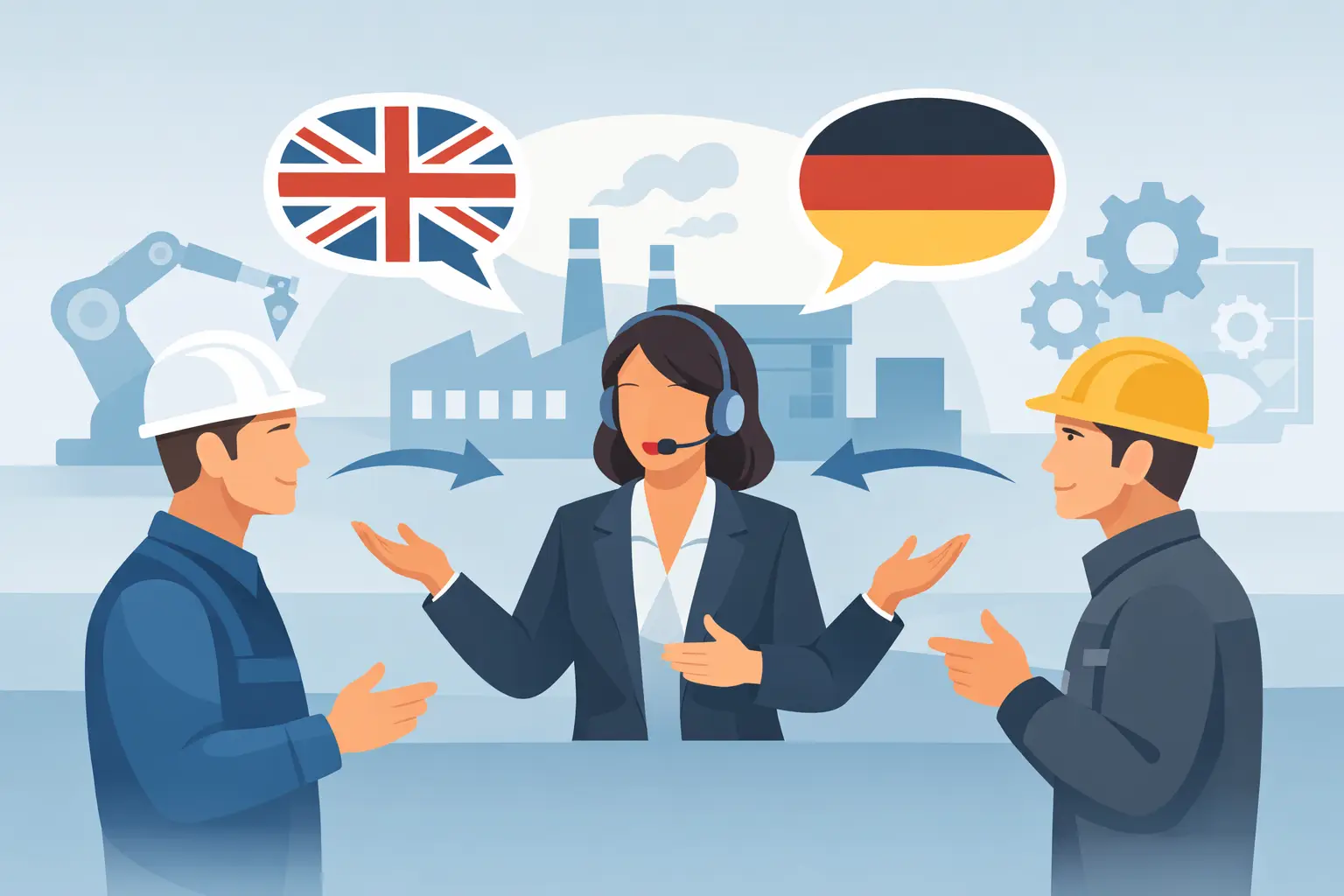
A commissioning meeting runs late, the German engineers switch to shorthand, and the English-speaking site team starts making assumptions. That is the moment an English–German technical interpreter stops being a convenience and becomes a control measure. In industrial settings, one mistranslated tolerance, alarm message or maintenance instruction can slow a project, trigger rework or create a safety risk that should never have existed.
If you are managing a factory build, plant upgrade, SAP rollout or technical training programme in Hungary, language support is not an administrative detail. It sits directly inside delivery, compliance and cost control. The question is not whether people speak English or German well enough for small talk. The question is whether they can interpret specialised technical content accurately, under pressure, in front of the people whose decisions affect uptime, safety and budget.
What an English–German technical interpreter actually does
A true technical interpreter works inside specialist context. That means understanding how terminology behaves in real operations, not just in a dictionary. In a power plant environment, for example, the interpreter needs to know whether the discussion concerns commissioning, outage planning, control systems, lockout procedures or contractor coordination. In automotive manufacturing, they need to follow production logic, tooling references, quality language and training instructions without forcing engineers to simplify every sentence.
That difference matters because technical conversations are rarely tidy. People interrupt each other, use acronyms, refer to drawings, point at equipment, skip steps and assume shared knowledge. A general interpreter may capture the broad meaning but miss the operational intent. A specialist interpreter is there to preserve meaning at the level where work can actually be executed.
Why English–German technical interpreter support matters on-site
On-site, communication failures do not stay theoretical for long. They become missed deadlines, incorrect settings, failed audits, poor training outcomes and preventable incidents.
Consider a machinery installation where the German supplier explains calibration limits and startup sequence to an English-speaking contractor team. If the interpreter does not recognise the significance of a specific parameter or safety interlock, the team may proceed with the wrong assumption. The cost then appears in extra labour, delayed handover or equipment damage. The original language error may take hours or days to uncover, but the financial impact starts immediately.
The same applies during EHS briefings. Safety language must be exact. Not roughly right, not close enough, and not dependent on what the listener thinks was meant. Where hot work permits, confined space access, chemical handling or emergency procedures are involved, imprecision is unacceptable. A qualified technical interpreter helps ensure the instruction delivered is the instruction understood.
The business case is risk reduction, not language support
Many buyers first search for an interpreter because two teams need to communicate. The better reason to appoint one is to reduce exposure.
An English–German technical interpreter supports project continuity in several ways. They reduce the chance of rework when technical instructions are passed between international teams. They help training land properly so operators and maintenance staff can apply what they have been shown. They support audit readiness by making sure process explanations, compliance discussions and corrective actions are communicated clearly. They also protect tempo. Meetings move faster when participants can speak precisely instead of slowing themselves down to avoid misunderstandings.
There is, of course, a cost to specialist interpreting. But compared with one day of commissioning delay, one avoidable shutdown or one supplier dispute caused by ambiguous language, the economics are usually straightforward.
Where companies need an English–German technical interpreter most
The need is strongest wherever language and technical complexity meet. Factory construction projects are an obvious example because they combine design, installation, safety coordination and investor reporting. But demand often intensifies later, when systems have to be tested, accepted and handed over.
SAP implementations are another high-risk area. These projects often look administrative from the outside, yet the real pressure sits at the point where system logic meets plant reality. If process owners, consultants and operational staff do not fully understand each other, configuration decisions can be made on flawed assumptions. The result is not just confusion in workshops. It can be poor adoption, reporting errors and costly post-go-live corrections.
Workforce training is equally sensitive. If a trainer explains a maintenance routine, operating limit or fault response in German and the local team receives an unclear English version, the training event may still appear successful on paper. The weakness only surfaces later, when staff carry out the task incorrectly or hesitate in front of equipment.
Plant visits, investor tours and technical due diligence meetings also require more than polite bilingual support. These settings often involve complex questions asked at speed, with financial decisions hanging on the quality of the answers. Precision shapes credibility.
Not every interpreter is suitable for technical work
This is where procurement mistakes often begin. A fluent bilingual professional is not automatically a technical interpreter. The role requires language skill, memory, subject familiarity, composure and the judgement to ask for clarification at the right moment.
Industry knowledge should shape assignment decisions. An interpreter who performs well in general business meetings may struggle in petrochemicals, energy or automotive manufacturing if the terminology is unfamiliar. Even within industrial sectors, the fit matters. Mechanical installation, process engineering, electrical systems and ERP implementation each bring their own vocabulary and working assumptions.
The practical question for buyers is simple: can this interpreter follow the discussion without turning specialists into language teachers? If the answer is uncertain, the assignment carries avoidable risk.
How to choose the right English–German technical interpreter
Start with the environment, not the language pair alone. What kind of site, system or process will be discussed? Who will be speaking? Are the conversations formal presentations, fast-moving shop floor exchanges, audits, training sessions or negotiation-heavy meetings? The best interpreter for a conference may not be the right one for a commissioning floor.
Next, assess terminology exposure. Ask whether the interpreter has worked in your sector before and whether they understand the practical context behind the terms. It is one thing to recognise a translated phrase. It is another to know what it means when an engineer refers to a deviation, bypass, purge cycle or FAT issue in the middle of a live discussion.
Preparation also matters. Even highly experienced interpreters perform better when they receive agendas, equipment lists, process descriptions, abbreviations and participant roles in advance. That is not a sign of weakness. It is part of professional risk control.
Finally, think about continuity. If your project includes multiple stages, the value of keeping the same interpreter or coordinated interpreting team can be significant. Terminology consistency improves, context is retained and time is not lost re-explaining the basics at each milestone.
On-site realities in Hungary
For international companies operating in Hungary, the communication chain can be more layered than expected. A single meeting may involve German engineers, English-speaking regional management, Hungarian operational staff and external contractors. Even if English is the nominal project language, key technical content is often introduced or clarified in German.
That mixed-language reality is why specialist support matters. You do not need an interpreter who simply transfers sentences. You need one who can preserve technical intent across a multilingual industrial environment where timing, safety and accountability are already under pressure. This is exactly where a specialist provider such as BeneDictum can make the difference between a meeting that merely happens and one that moves the project forward cleanly.
Accuracy is not absolute – but it must be operational
There is one useful nuance here. Technical interpreting is not about producing textbook-perfect language in every moment. On a busy site, speech is fragmented and conditions are rarely ideal. The real standard is operational accuracy: the message transmitted clearly enough for the right action to follow.
That means the best interpreters do more than translate words. They preserve intent, flag ambiguity and maintain discipline when discussions become cluttered. Sometimes that requires slowing a speaker briefly to avoid a larger mistake later. In high-stakes environments, that is not disruption. It is good project practice.
When equipment is being installed, processes are being validated or staff are being trained on systems they must trust, communication quality has direct commercial value. A capable English–German technical interpreter protects that value in real time, where mistakes are hardest to reverse.
If your next meeting includes safety instructions, process settings, system logic or investment-critical discussion, treat interpreting as part of project control from the start. It is far cheaper to get the terminology right in the room than to pay for the consequences afterwards.
0 hozzászólás