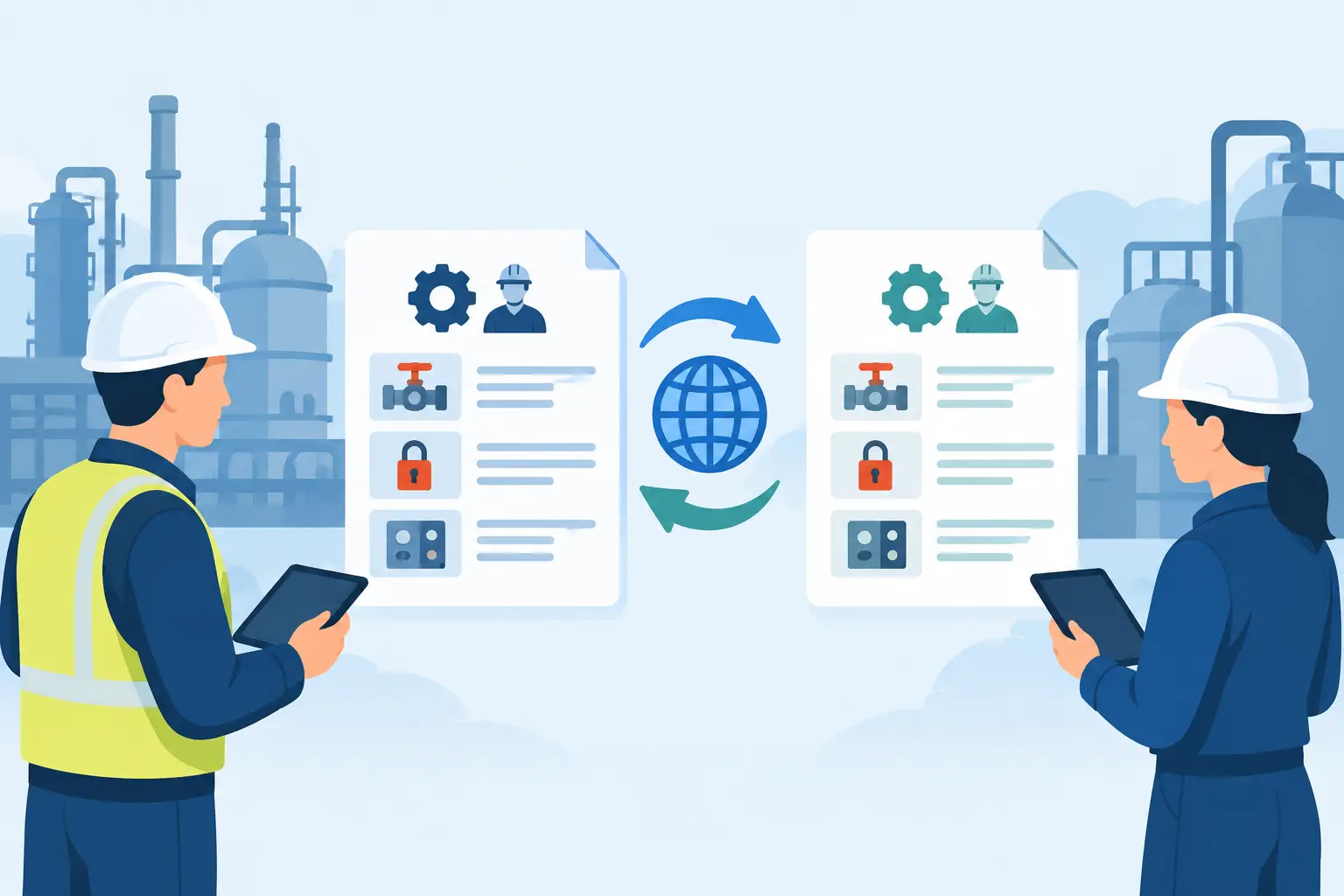
A shutdown procedure that says “isolate the line” is not a simple instruction when the work involves pressurised steam, hazardous chemicals, rotating equipment or a live electrical supply nearby. One ambiguous term can leave a contractor working under the wrong permit, isolate the wrong circuit or delay a restart that costs thousands per hour. Knowing how to translate maintenance shutdown procedures is therefore a safety and operational control, not a document administration task.
For industrial sites working across English, German, Hungarian and other languages, the objective is not word-for-word equivalence. The translated procedure must enable every person involved – operators, maintenance teams, EHS specialists, contractors and supervisors – to perform the same safe action, in the same sequence, under the same conditions.
Start with the shutdown context, not the source text
A maintenance shutdown can range from a two-hour intervention on a packaging line to a planned outage at a power station or petrochemical unit. Translation requirements change accordingly. Before translating, establish what is being shut down, why the work is taking place, who will use the procedure and which documents govern the activity.
A procedure for replacing a conveyor motor may refer to local isolation points, a lockout-tagout process and a standard work permit. A turbine outage may also involve process depressurisation, inerting, confined-space entry, scaffolding, lifting plans, environmental controls and phased commissioning. The translator must understand the operating context well enough to distinguish a routine instruction from a critical control.
Request the related documentation before work begins. This commonly includes P&IDs, equipment lists, electrical single-line diagrams, lockout registers, permit templates, risk assessments, method statements, previous shutdown reports and the site terminology list. These materials expose the names used on site for valves, cabinets, process units and safety systems. Without them, even a linguistically fluent translator may select a technically wrong term.
How to translate maintenance shutdown procedures without creating risk
The safest process treats translation as a controlled technical workflow. It begins with source-document review and ends with user validation on the actual site.
Separate instruction from explanation
Shutdown documents often mix mandatory actions with background information. In translation, the distinction must remain visible. “Close valve XV-204 before opening drain DV-204” is an operational command. “The line may retain residual pressure” is a warning that explains why the command matters. Both are essential, but they should not be softened, merged or rearranged.
Preserve numbering, equipment tags, alarm names, set points, units and references exactly where they are part of the control process. If the source says 6 bar, the translation must not introduce uncertainty over gauge pressure, absolute pressure or an incorrectly converted value. Where the source itself is unclear, flag it for engineering review rather than guessing.
Translate the function, then verify the term
Technical terms are rarely interchangeable simply because a dictionary offers a close match. “Isolate”, “disconnect”, “shut off”, “de-energise” and “make safe” may each have different implications depending on the discipline. In electrical work, isolation may require a proven dead condition, locking, tagging and verification. In process work, isolation can require double block and bleed, physical disconnection or a spade insertion.
Translate the intended function first: what must happen physically, which energy source is controlled and how is the safe state confirmed? Then select the approved target-language terminology used by the client, equipment manufacturer and applicable site system.
This is particularly important where English source documents use shortened language. An instruction such as “LOTO pump P-17” may be understood by an experienced maintenance team, but its target-language version should accurately reflect the local lockout-tagout procedure. If the site uses a specific formal term in its permits and training records, use that term consistently.
Protect sequence and conditional logic
A shutdown is a chain of dependencies. A line may need to be flushed before isolation, cooled before opening, tested before entry and signed off before handover. Translation must preserve sequence words such as “before”, “after”, “only when”, “unless”, “while” and “do not proceed until”. A minor grammatical error in these phrases can reverse the required action.
Pay close attention to conditional statements. “Do not remove the blind until the pressure indicator reads zero” is not the same as “remove the blind when pressure is low”. Similarly, an instruction that permits a bypass during testing does not authorise its use during normal operation. Technical translators should mark unclear logic, contradictory steps and incomplete cross-references for resolution by the procedure owner.
Keep terminology consistent across the shutdown pack
During a large outage, personnel may use a master plan, area instructions, permits, isolation certificates, toolbox-talk materials and contractor briefings. If one document says “emergency stop”, another says “trip switch” and a third uses a local abbreviation, teams can lose time confirming whether they refer to the same device.
Create a project glossary before translating the full pack. It should capture approved names for equipment, process media, safety devices, job roles, permit statuses and common actions. Include the equipment tag alongside the term where possible. A glossary is not bureaucratic overhead. It prevents expensive rework when late document revisions arrive and several translators or interpreters are involved.
Give safety language special treatment
Safety-critical wording deserves a separate quality check because its consequences are immediate. Warnings, prohibitions and emergency instructions should be unmistakable to the people doing the work, including contractors who may be unfamiliar with the site.
Check that the translation clearly communicates these four controls:
- the hazard, such as stored energy, toxic exposure, hot surfaces or unexpected start-up;
- the required protective measure, including PPE, isolation or exclusion zones;
- the verification step that proves conditions are safe; and
- the authority to stop work or escalate an abnormal condition.
Do not assume that a literal translation of a legal or safety term carries the same status in another language. Terms linked to national regulations, site permits or corporate EHS systems may need an approved equivalent, an explanatory phrase or review by the responsible safety professional. This depends on the jurisdiction and the document’s purpose. A training handout can sometimes include clarification; a controlled permit form may require exact approved language and format.
Build review into the shutdown schedule
The worst time to discover a translation issue is during a night shift, when contractors are waiting and an isolated asset must return to service by morning. Translation needs a realistic place in the shutdown plan, including time for technical queries, revision control and approval.
Use a two-level review. First, a translator with relevant industrial knowledge checks terminology, instructions, units and document structure. Second, a site subject-matter expert verifies that the translated process matches the plant’s actual configuration and rules. The translator confirms linguistic and technical meaning; the engineer or operations owner confirms operational authority.
For major projects, arrange a pre-shutdown terminology meeting with operations, maintenance, EHS and the language team. Review difficult terms such as isolation boundaries, valve positions, permit roles and restart criteria. This short meeting can prevent repeated queries throughout the outage.
Version control is equally critical. Every translated revision should identify the source revision, date, owner and affected pages or sections. If a late engineering change alters a line-up, an interlock or an acceptance criterion, distribute the amended translation through the same controlled channel as the original. Printing an updated page without clear revision information creates a genuine risk of parallel, conflicting instructions on site.
Plan for spoken communication as well as written procedures
A flawless translated document does not remove the need for specialist interpreting during shutdown execution. Toolbox talks, permit handovers, isolation walkdowns, incident discussions and restart meetings often involve questions that were not anticipated in the written procedure.
The interpreter needs the shutdown pack and glossary in advance, plus enough familiarity with the plant area to follow equipment references and safety discussions. General business interpreting is not sufficient when a supervisor is confirming a blind location, a control-room operator is describing an alarm condition or an engineer is deciding whether a test result permits restart.
BeneDictum supports these assignments with technical language professionals selected for relevant industrial knowledge. The commercial value is straightforward: clear communication reduces waiting time, avoids repeated briefings and helps prevent a local misunderstanding from becoming a safety event or delayed production start.
Treat restart as part of the translation scope
Shutdown procedures often receive close attention, while restart instructions are translated late or handled as an afterthought. That is a costly mistake. Restart can involve removal of locks and blinds, reinstatement of guards, functional tests, alarm checks, leak tests, permit closure and formal handover to operations. Each step needs the same precision as the isolation process.
Make sure the translated documentation distinguishes between work completion and readiness to operate. A maintenance task may be complete while the asset remains unavailable because documentation, inspection, cleaning, calibration or authorisation is still outstanding. Clear target-language wording helps managers see which condition has actually been achieved.
The useful test is simple: could a qualified worker who reads only the translated procedure isolate, maintain and return the asset to service exactly as the approved source intends? If the answer is anything less than yes, resolve the gap before the shutdown window opens. That discipline protects people first, but it also protects the production plan that depends on a controlled restart.
0 hozzászólás