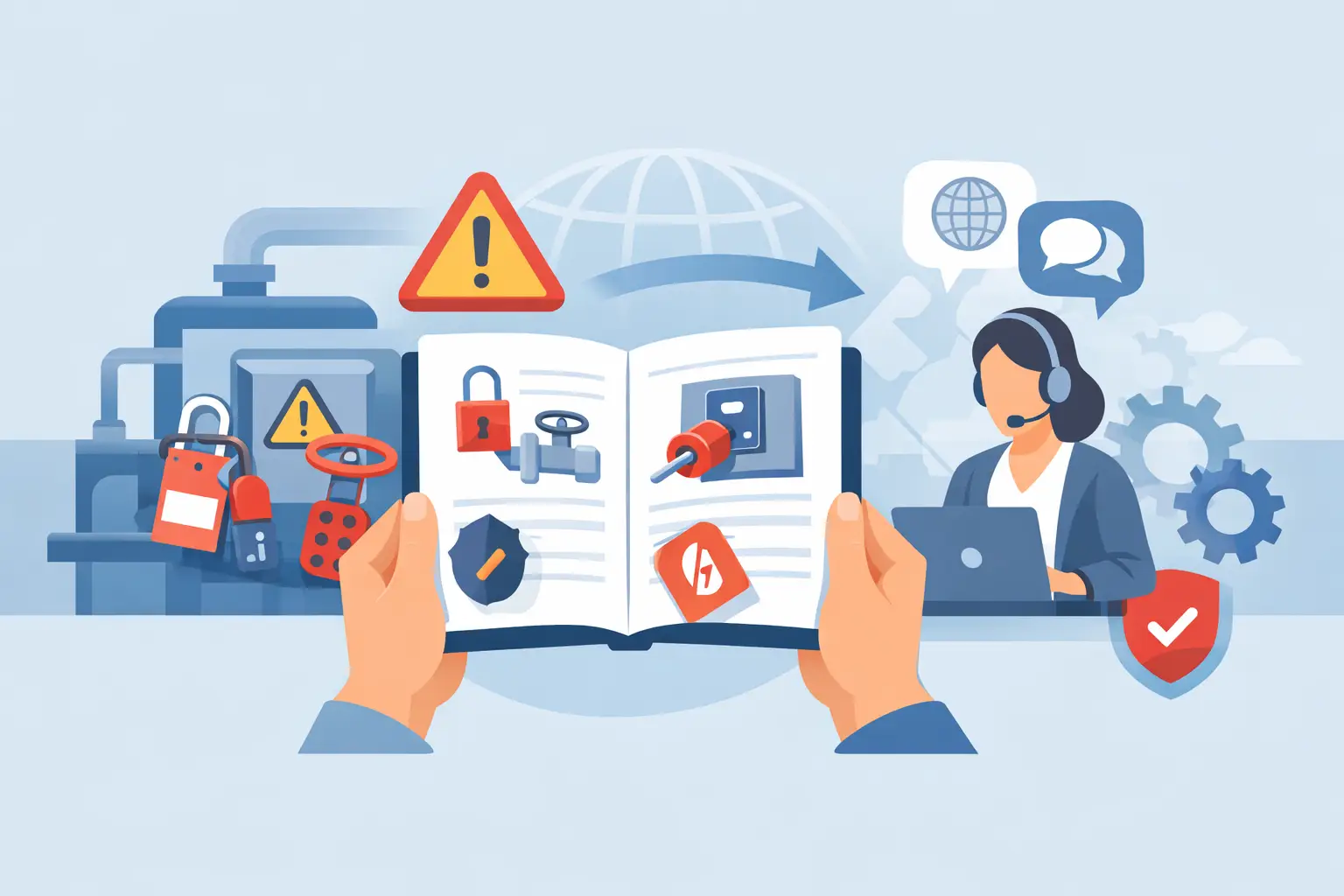
A lockout-tagout mistake rarely looks dramatic at first. It starts with one unclear instruction, one mistranslated step, or one technician who thinks isolation has been completed when it has not. That is why a loto procedure translation service is not a back-office purchase. In industrial environments, it is part of risk control.
When teams work across English, German and Hungarian, LOTO documentation has to do more than read well. It has to hold up on the plant floor, during training, in audits and under pressure during maintenance shutdowns. If a translated procedure leaves room for interpretation, the cost may be measured in delayed restarts, damaged equipment, failed compliance checks or serious injury.
Why LOTO translation needs technical judgement
LOTO procedures sit at the intersection of safety, maintenance and operations. They describe how to isolate hazardous energy, verify zero-energy state, secure equipment against unexpected start-up and return systems to service safely. That sounds straightforward until the procedure covers multiple energy sources, interlocks, stored pressure, hydraulic lines, thermal energy or plant-specific control logic.
A general translator may understand the language but still miss the operational meaning. Terms such as isolation point, bleed-off, dissipation, try-out, residual energy and authorised person are not interchangeable. Neither are stop, switch off, disconnect, de-energise and lock out. In ordinary business writing, small differences can be tolerated. In a LOTO document, they can create dangerous assumptions.
This is where specialist technical translation matters. The translator must understand how procedures are actually used in refineries, power plants, automotive lines and manufacturing sites. They need to know when wording should follow internal EHS language, when it must mirror machine documentation, and when a literal rendering creates more risk than a functional technical equivalent.
What a loto procedure translation service should actually deliver
A proper loto procedure translation service should not treat the text as a simple document conversion job. It should produce a usable safety document that supports compliance and safe execution in the real environment where it will be read.
That means terminology has to stay consistent across the full procedure set. If one section refers to a main isolator and another to a primary disconnect switch for the same component, confusion begins immediately. If permit-to-work language differs from the site standard, supervisors and contractors may apply the wrong process. If warnings are grammatically correct but operationally vague, the translation has failed its purpose.
A dependable service should also account for the audience. A procedure written for experienced maintenance engineers is not the same as a training instruction for new operators or external contractors. The level of explicitness, sentence structure and terminology choice may need to change depending on who is expected to follow the document.
In practice, the best results come from translators who work with technical source material every week and understand the consequence of poor wording. BeneDictum Kft. positions this correctly – technical language support in industrial settings is a safeguard against downtime, safety failures and expensive misunderstanding, not an administrative formality.
Where translation errors cause the greatest exposure
Some parts of a LOTO procedure carry more risk than others. Equipment identification is one obvious example. If the translated procedure does not clearly distinguish between adjacent lines, duplicate valves, similar motors or parallel systems, the wrong asset may be isolated.
Verification steps are another weak point. Many incidents happen not during shutdown but during confirmation. The wording around test-before-touch, proving isolation, checking stored energy and validating zero state must be precise. A phrase that sounds acceptable in an office can become dangerously loose on the shop floor.
Restart instructions deserve equal attention. Re-energisation often involves more than removing locks. Guards may need to be reinstalled, permit status checked, affected personnel informed and process conditions verified. If the translated text compresses or softens these steps, the risk shifts from maintenance to live operation.
Then there is the issue of role definition. LOTO procedures often separate responsibilities between operators, maintenance teams, supervisors, permit issuers and authorised employees. If the translated version blurs who is allowed to do what, accountability disappears at exactly the point where control should be strongest.
Loto procedure translation service in multilingual plants
In Hungary, multilingual industrial projects are common. A new production line may be designed by a German supplier, commissioned with English-language documentation and handed over to a Hungarian operating team. During that process, LOTO instructions often pass through several hands, each with a different assumption about terminology.
This is where a loto procedure translation service becomes commercially valuable. It aligns operational language across departments and project phases. Training becomes more consistent. Audits are easier to manage. Contractors understand the same isolation logic as the internal team. Most importantly, the plant reduces the chance that a safety rule changes meaning when it changes language.
For project managers, this matters because delays linked to procedural confusion are expensive. For EHS leaders, it matters because safety systems only work when people understand them in clear, actionable terms. For procurement and investment stakeholders, it matters because poor translation can undermine the value of otherwise well-designed equipment and procedures.
Translation alone is not always enough
There are cases where translated LOTO documentation still fails, even when the language itself is accurate. Usually the problem lies upstream. The source text may be inconsistent, copied from another site, too reliant on internal shorthand or written by someone who assumes background knowledge that external teams do not have.
A serious provider should flag these issues instead of translating them blindly. If the original procedure confuses shutdown with full isolation, or mixes machine guarding instructions with energy isolation steps, the translation process should identify that risk. The goal is not to preserve every weakness in another language. The goal is to produce a document that supports safe operation.
This does not mean translators should rewrite plant policy without approval. It means they should recognise when the source creates ambiguity and raise it before that ambiguity is multiplied across training materials, permits and work instructions.
How to assess a LOTO translation provider
If you are buying this service, the right question is not simply, “Do they translate Hungarian, English or German?” The better question is, “Can they translate energy isolation procedures in a way that stands up in a real industrial environment?”
Look for technical specialisation, not general language claims. Ask whether the provider has experience with manufacturing, power generation, petrochemical operations or automotive systems. Check whether they work with EHS content, maintenance procedures and equipment documentation regularly. Ask how they manage terminology approval, consistency across document sets and unclear source material.
It is also worth considering whether you need written translation alone or a combination of translation and on-site technical interpreting. Many LOTO failures happen during rollout, not during document preparation. A translated procedure may be correct, but if training is interpreted badly during commissioning or contractor induction, the safety benefit is lost. In those situations, written and spoken technical language support should work together.
The business case is straightforward
Companies rarely struggle to understand the cost of production downtime, failed startup sequences or reportable safety incidents. What they sometimes underestimate is how often those failures begin with language that seemed good enough.
A proper loto procedure translation service reduces that exposure. It supports safer maintenance, clearer training, better audit readiness and more reliable cross-border execution. It also protects the investment already made in equipment, systems and site rules by ensuring those controls are understood as intended.
There is, of course, a trade-off. Specialist technical translation costs more than generic document translation. But the comparison should be made against operational risk, not against the cheapest line item on a procurement sheet. If one mistranslated step can stop a line, damage an asset or place a worker in danger, the lowest quote is rarely the lowest cost.
When LOTO instructions are being translated, the standard should be simple: would you trust this wording during a shutdown at 2 am, with contractors on site and pressure to restart? If the answer is anything less than yes, the document is not ready. In industrial safety, clarity is not a nice extra. It is part of control.
0 hozzászólás