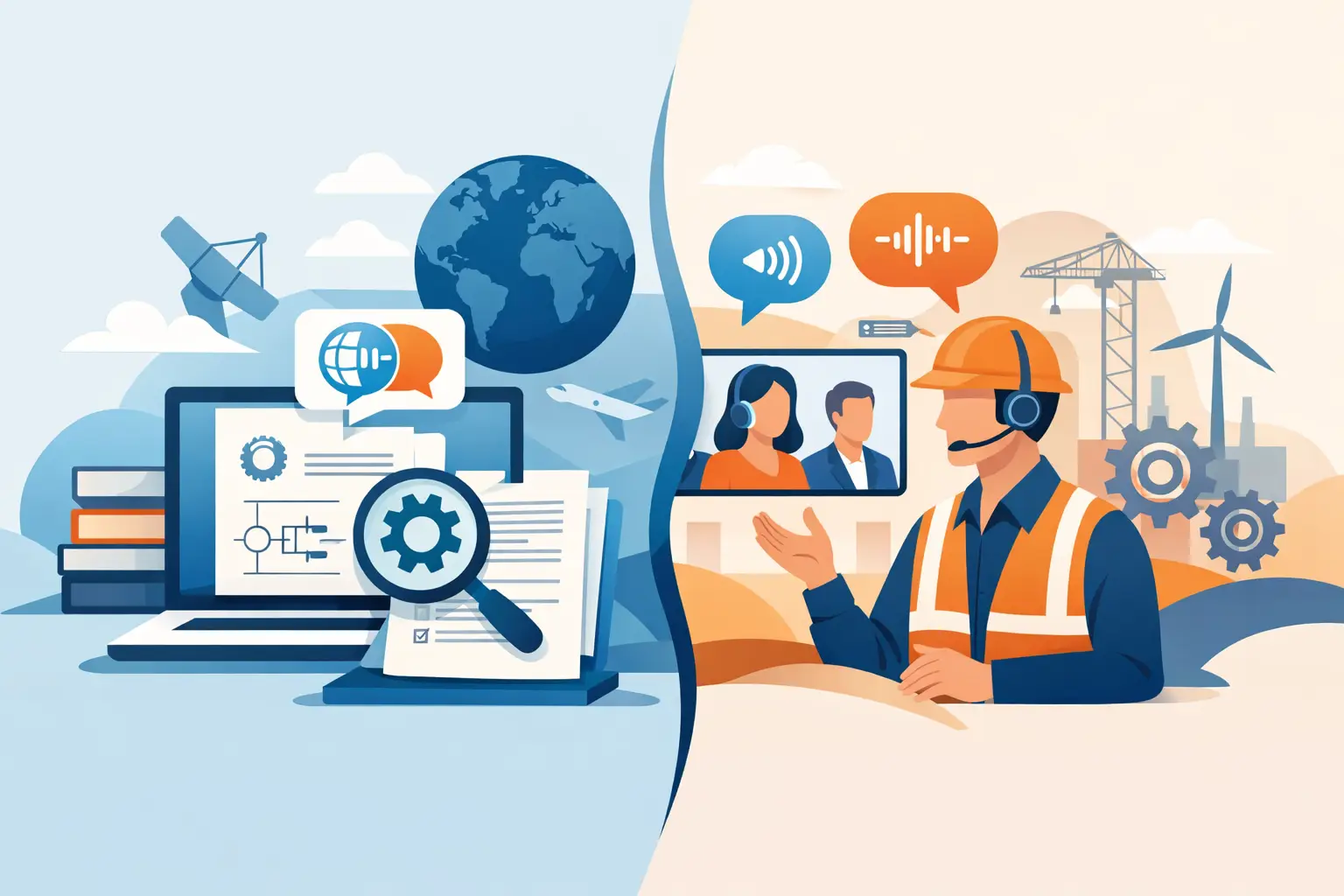
A commissioning meeting is delayed because a German engineer explains a pressure-test exception that nobody on the Hungarian contractor team fully understands. The document was translated last week, but the decision being made now is spoken, technical and time-critical. This is where translation vs interpreting for engineering stops being a linguistic distinction and becomes a project-control decision.
Choosing the wrong service can create avoidable rework, failed training, unsafe maintenance activity and expensive downtime. Choosing the right one gives technical teams the shared understanding they need to act correctly the first time.
Translation vs interpreting for engineering: the core difference
Translation deals with written material. It converts documents such as operating manuals, work instructions, risk assessments, SAP documentation, specifications, audit findings and contracts from one written language into another.
Interpreting deals with spoken communication. An interpreter enables people speaking different languages to communicate during a plant visit, toolbox talk, workshop, installation meeting, training session, safety briefing or live troubleshooting call.
The distinction sounds straightforward, but industrial projects frequently require both. A translated lockout-tagout procedure does not help if the supervisor delivering the briefing cannot explain its application accurately to a multilingual workforce. Equally, an excellent interpreter cannot replace a properly translated and checked maintenance instruction that must remain on file for years.
The question is not which service is better. The question is: where is the message being delivered, who must act on it, and what does an error cost?
When engineering translation is the right choice
Use technical translation when the information must be read, reviewed, approved or retained in written form. This commonly applies before a project begins, throughout formal documentation cycles and whenever the text may be used as evidence of compliance, quality or contractual performance.
For example, an automotive supplier may need a German machine manual translated into Hungarian before operators receive equipment training. A power-generation project may require English method statements, permits and inspection records translated for local teams. During an SAP implementation, process descriptions, configuration guidance and user documentation often need consistent terminology across several departments.
Written engineering translation allows time for research, terminology validation and quality control. That matters when one term can change the practical meaning of an instruction. Consider the difference between an emergency shut-off, an isolation valve and a control valve. They may all relate to flow, but they serve different operational and safety functions. Replacing one with a broad or inaccurate equivalent can lead a technician to the wrong action.
Translation is also the better choice where wording must remain stable. A quality procedure, electrical diagram note or environmental permit cannot depend on what participants remember from a meeting. It needs a clear written version that people can consult later.
Translation requires more than bilingual writing
Technical texts are rarely difficult because of vocabulary alone. They contain abbreviations, references to standards, product-specific naming conventions and instructions that depend on the equipment context. A translator working on a petrochemical turnaround, for instance, must understand whether a term refers to a vessel, line, flange, instrument loop or isolation point.
This is why general translation is a poor fit for high-stakes engineering material. The objective is not merely readable text. It is a document that technical personnel can use safely and correctly.
When technical interpreting is essential
Use interpreting when the work is happening live and people need to ask questions, test understanding, make decisions or respond to a change immediately. This is particularly common on sites where international OEM engineers, local contractors, project leaders and operators work together.
At a factory construction site, an interpreter may be needed during daily coordination meetings, equipment installation, acceptance testing and handover. At an energy facility, the assignment may involve a safety briefing before maintenance starts, followed by real-time communication between specialist contractors and the operations team. During workforce training, interpreting allows trainees to interrupt, clarify and confirm the exact sequence of a task.
The value is clearest when the conversation is not predictable. A written agenda may say “review commissioning progress”, but the actual meeting may move quickly into sensor faults, software parameters, missing parts and revised deadlines. The interpreter must follow the technical content while managing the pace of discussion and preserving the meaning of questions, warnings and decisions.
In these situations, waiting for a written translation is not realistic. A delayed answer can mean a stopped line, idle contractors or a safety-critical decision made with incomplete information.
Consecutive or simultaneous interpreting?
Most site meetings, training sessions and operational discussions use consecutive interpreting. The speaker pauses at logical intervals, allowing the interpreter to render the message accurately. This format supports questions and clarification, which is often valuable when procedures or risks are being discussed.
Simultaneous interpreting is more suitable for conferences, large presentations or formal events where speakers need to continue without frequent pauses. It normally requires appropriate technical arrangements and, for longer sessions, more than one interpreter. The right format depends on the group size, schedule, subject matter and level of interaction required.
For engineering work, accuracy should take priority over speed alone. If a complex explanation of a control system needs to be broken into manageable sections, that is usually a worthwhile trade-off. A few extra minutes in a meeting is less costly than hours of fault-finding caused by a misunderstood instruction.
Where projects need both services
The highest-risk assignments commonly combine translation and interpreting rather than choosing one exclusively.
Take the installation of a new production line in Hungary. Before the equipment arrives, the client may need machine documentation, safety requirements and installation plans translated. During construction and commissioning, technical interpreters support daily meetings, site inspections and discussions with overseas engineers. Once the line is operational, training materials need translating and the first operator sessions may require interpreting. Later, audit reports, corrective-action plans and revised procedures may return to translation.
The same pattern applies to SAP projects. Written process maps, training guides and system documentation require translation. Workshops on master data, authorisations, testing and go-live support require interpreting. If terminology is inconsistent between the two, users can be trained on labels that do not match their written instructions or system environment.
One language partner should therefore manage terminology across both streams. Terms agreed in the manual should be the same terms used in the training room and on the shop floor. Consistency reduces the need for repeated explanation and helps teams build confidence in the process.
How to assess the risk before booking
Procurement teams often compare language services by hourly or per-word rate. That is understandable, but it overlooks the far larger cost attached to an unsuitable assignment. A lower-priced generalist may be adequate for routine correspondence. It is not necessarily adequate for a pressure-test briefing, EHS audit or technical dispute during plant acceptance.
Before commissioning a service, establish four practical facts:
- Is the source information written, spoken or both?
- Does the audience need to make a live decision or carry out physical work?
- Is specialist terminology central to the discussion?
- What are the consequences if a term, value or instruction is misunderstood?
If a misunderstanding could affect safety, production, compliance, quality or a contractual milestone, specialist support is justified. The interpreter or translator should have relevant field knowledge, preparation time and access to available reference material. Sending manuals, agendas, drawings, glossaries and previous reports in advance is not administrative overhead. It is part of risk control.
What specialist engineering language support looks like
A capable technical language provider does not assign people purely by language pair. The assignment must match the sector and environment. Automotive production, power generation and petrochemistry each have distinct equipment, operating practices and terminology. An interpreter experienced in a boardroom setting may not be suitable for a shutdown meeting beside live industrial equipment.
Preparation also matters. A certified technical interpreter should know the purpose of the meeting, participants, working languages, site rules and key terminology before arriving. For a multi-day project, continuity is equally valuable. The same professional can retain project vocabulary, understand previous decisions and avoid the repeated briefing that occurs when personnel change without handover.
BeneDictum approaches technical translation and interpreting as connected safeguards for industrial communication. Whether the assignment involves an on-site safety briefing, a plant visit, a complex training programme or technical documentation, the aim is the same: make sure every participant understands what must happen next.
When a project team is discussing equipment, safety or system changes, language support is not an accessory to the work. It is part of the control system that keeps the work moving in the right direction.
0 hozzászólás