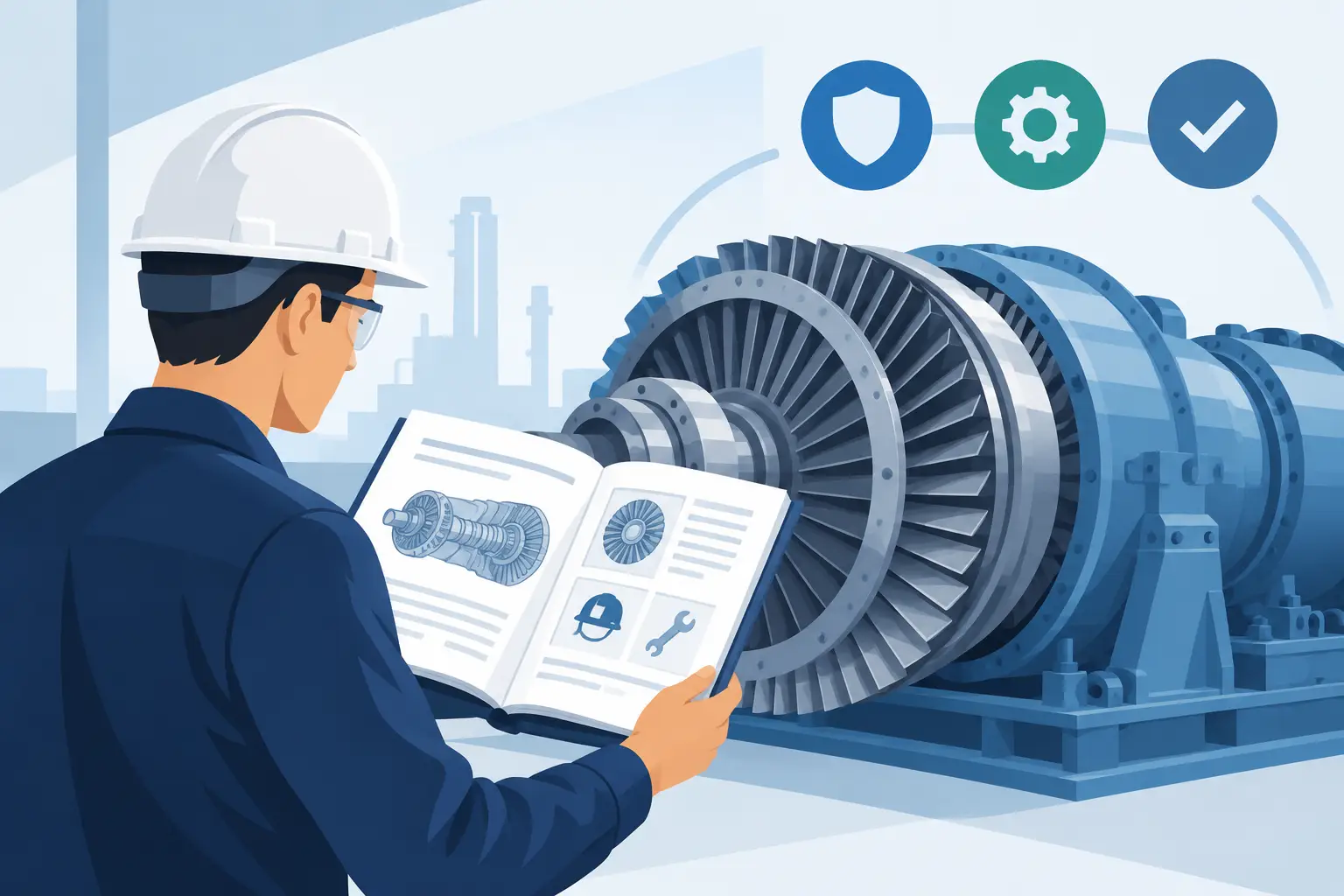
A turbine manual is often opened when time is already under pressure: during commissioning, a trip investigation, a planned outage or a fault that is stopping production. A turbine manual translation guide must therefore address more than language. It must protect the chain of decisions between the manufacturer’s instruction, the control room, the maintenance team and the person carrying out the work.
One incorrect term can change a safe sequence into an unsafe one. If a German instruction distinguishes between a shutdown, a trip and an emergency stop, the English version cannot treat them as interchangeable. The same applies to set points, locking devices, turning gear procedures, lubrication requirements and alarm acknowledgements. In energy and industrial environments, a translation error can mean delayed restart, damaged equipment, injury or a reportable compliance failure.
Why turbine manual translation is a risk-control task
Turbine documentation sits at the point where engineering design becomes operational action. It may include installation instructions, operating manuals, maintenance schedules, inspection reports, control-system screens, safety procedures and spare-parts information. Each document has a different function, but all must use the same approved terminology.
Consider a maintenance team preparing to inspect turbine bearings after an abnormal vibration reading. The manual may specify permissible clearances, measurement positions, oil conditions and torque values. A mistranslated unit, an unclear reference to a bearing location or a softened warning can lead to incorrect assembly. The turbine may then return to service with an avoidable defect that appears only under load.
This is why general translation capability is not enough. The linguist must understand the technical relationship between components and the consequence of each instruction. They must also recognise when a phrase is manufacturer-specific, legally controlled or ambiguous in the source text. Translation should not conceal uncertainty. It should identify it early, while an engineer can still confirm the intended meaning.
The documents that require the closest control
Not every file carries identical risk. A presentation for a plant visit can tolerate a more flexible style than a lock-out procedure. Project managers should classify turbine documents before translation begins, then set the level of technical review accordingly.
The highest-control category usually includes operating and emergency procedures, commissioning instructions, isolation plans, maintenance and overhaul manuals, control-system documentation, safety data, inspection criteria and training materials used by operators. These documents direct physical work or influence safety-critical decisions.
Commercial specifications, tender documents and equipment brochures still need accurate terminology, particularly where performance guarantees, delivery scope or liability are concerned. However, they normally require a different review process from a manual that tells an engineer how to remove a coupling guard or restore an interlock.
Warnings cannot be translated by tone alone
Safety labels such as Danger, Warning, Caution and Notice may be defined by the manufacturer’s documentation system or by applicable standards. Their translation must preserve both the hazard level and the action required. A phrase such as “do not operate unless the barring device is disengaged” needs precise handling. It is not marketing language. It is an operational prohibition with a direct mechanical consequence.
The surrounding text matters too. A warning may rely on a previous step, a drawing reference or a condition such as rotor temperature, pressure release or electrical isolation. Translating the sentence correctly while breaking its connection to the procedure is still a failure.
Build the terminology before translating at volume
The strongest turbine manual translation projects start with a controlled glossary. This is not a simple bilingual word list. It records the approved term, context, source reference, abbreviation, preferred spelling and any term that must remain in the original language.
For example, the project team may need to decide how it will handle terms for inlet guide vanes, gland steam, turning gear, overspeed protection, lube oil and vibration probes. The choice should be informed by the turbine type, the manufacturer’s established usage, the client’s internal terminology and the language used in existing plant records. Consistency across manuals, SCADA screens, permits and training material is essential.
A glossary also prevents a common problem during multinational projects: different contractors using several names for the same component. If the electrical contractor, mechanical team and OEM representative refer to an item differently, fault-finding slows down and handovers become less reliable.
Use engineers to resolve genuine ambiguity
Translators should not guess when a source sentence is incomplete or technically unclear. A query process is needed. The translator raises the issue with a clear reference to the page, section, drawing or tag number; the client or manufacturer provides an engineering decision; and that decision is recorded in the glossary or translation memory for future use.
This takes time, but it is cheaper than issuing a manual that forces the site team to interpret the instruction themselves. It also creates a useful audit trail when documentation must be reviewed after an incident, a warranty discussion or a regulatory inspection.
Preserve numbers, references and document logic
Technical accuracy is not confined to terminology. Turbine manuals contain data that must survive translation without alteration: units, tolerances, torque values, part numbers, alarm limits, diagram call-outs, revision references and cross-references. A translated sentence may read well and still be dangerous if the value beside it has changed from 0.5 mm to 5 mm or if the reader is sent to the wrong figure.
Layout control therefore deserves a defined stage in the workflow. Tables must remain readable. Warnings must stay attached to the relevant task. Captions must match diagrams. Page breaks must not separate a step from its condition or safety instruction. Where text expansion affects a control panel screenshot, drawing or table, the document should be reformatted by someone who understands the operational importance of the content.
Version management is equally important. Plants often hold manuals that have been updated after modifications, software changes or component replacements. Translating an obsolete revision can be worse than having no translation at all because it creates false confidence. The project owner should confirm the source revision, document status and intended audience before work starts.
A practical turbine manual translation workflow
For high-stakes documentation, the process should be proportionate to risk and traceable from start to finish. A dependable workflow normally includes five controls:
- Source-file and revision verification, including drawings, appendices and embedded warnings.
- Terminology extraction and approval with input from engineers or OEM contacts.
- Translation by a linguist experienced in the relevant turbine, energy or industrial field.
- Independent technical editing that checks meaning, consistency, figures, units and references.
- Final layout, quality and release checks against the approved source version.
The level of review depends on the use case. A short maintenance bulletin may need rapid turnaround, while a complete commissioning manual may justify several review rounds and a bilingual engineering sign-off. Speed matters during an outage, but speed without control merely transfers risk to the site team.
Plan for the people who will use the manual
A translated manual succeeds only if it works at the point of use. Ask who will read it: operators on shift, fitters, EHS personnel, contractors, apprentices or visiting specialists. Their working language, technical background and access to supporting drawings will affect the final format.
If a Hungarian maintenance crew is working alongside German OEM engineers and an English-speaking project manager, one document alone may not solve every communication need. Critical procedures may require aligned multilingual versions, on-site technical interpreting during training or commissioning, and a shared terminology sheet for daily meetings. BeneDictum supports this combination of written translation and field-specific interpreting where project communication cannot be left to informal explanation.
Training materials deserve particular attention. A correctly translated manual does not guarantee correct learning if the trainer uses different terms, skips conditions or cannot clarify a question about the actual equipment. Aligning the translated manual with training slides, toolbox talks and live interpretation reduces the gap between documentation and practice.
Questions to ask before approving the final file
Before release, the responsible manager should be able to answer a few direct questions. Does every safety-critical instruction preserve the source meaning? Are all tag numbers, units, diagrams and cross-references correct? Has an engineer resolved every translation query? Is the manual the current revision? Can the intended user find and understand the procedure under real working conditions?
If any answer is uncertain, the file is not ready for operational use. Treat the final review as a safeguard for people, equipment and project continuity, not as an administrative sign-off.
A turbine will not compensate for an ambiguous instruction. The manual must give the person at the equipment the right words, the right values and the right sequence at the moment they need them.
0 hozzászólás