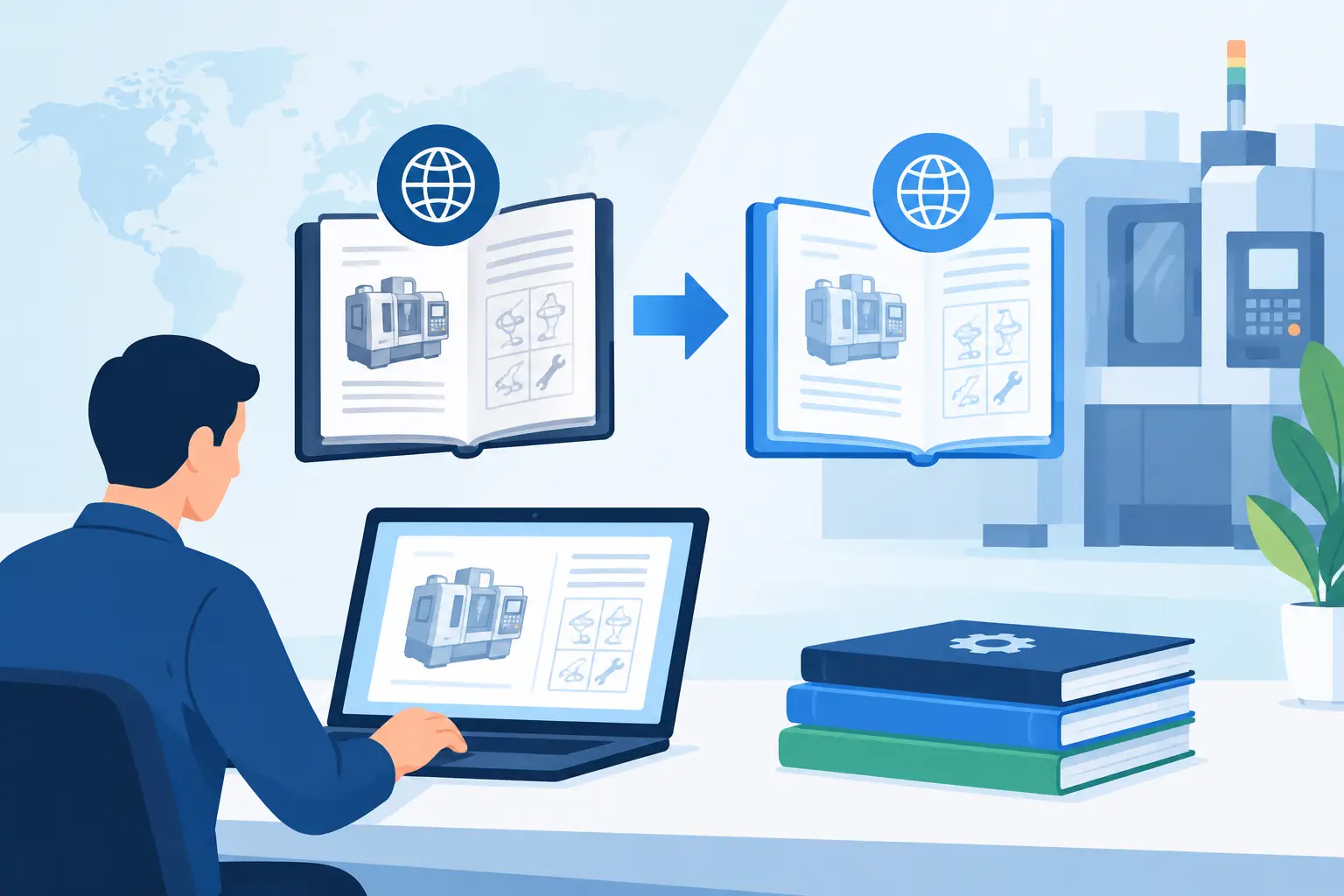
A manual can be technically correct in its source language and still create a serious site risk after translation. When you translate equipment operating manuals, a single wrong term can turn a routine maintenance instruction into an unsafe intervention, extend a shutdown or leave operators unable to respond correctly to an alarm.
For plant managers, project leads and EHS teams, this is not a formatting exercise. Operating manuals define how machinery is started, isolated, maintained, cleaned and returned to service. They often sit at the point where manufacturer requirements, legal duties and practical operator decisions meet. The translation must preserve that function without introducing ambiguity.
Why operating manual translation carries operational risk
An equipment manual may contain lockout procedures, pressure limits, electrical isolation sequences, torque values, chemical handling requirements and emergency-stop instructions. The language is dense because the process is dense. Translators who do not understand the equipment or its operating context can produce text that sounds fluent while changing the meaning that matters.
Consider a petrochemical installation where an instruction distinguishes between venting residual pressure and depressurising a vessel. The terms may appear close in everyday language, but they describe different actions and different safety controls. In automotive production, confusing a fixture with a tool, or a fault reset with a restart, can stop a line or expose staff to unexpected movement. At a power plant, an inaccurate instruction concerning interlocks or permissives can lead to a failed commissioning step and costly delay.
The financial impact is not limited to the translation budget. A poorly translated manual can cause failed training, longer maintenance windows, warranty disputes, failed audits and avoidable incidents. The right question is not whether the text has been translated. It is whether the translated manual enables a competent local operator to carry out the intended procedure safely and consistently.
Translate equipment operating manuals with the right technical context
Good technical translation starts before the first sentence is translated. The translator needs to know what the equipment does, who uses the manual and where it will be used. A manual for a packaging line has different terminology, operating risks and user expectations from a manual for a steam turbine, a welding cell or an SAP-controlled warehouse system.
Source material is often incomplete or assembled from several documents. It may include drawings, warning labels, HMI screenshots, parts lists, maintenance schedules and earlier versions of the manual. These materials should be reviewed together. A sentence that is unclear in isolation is often precise when read beside a schematic, a control-panel image or a sequence diagram.
Define the user and the operating environment
A translation for trained maintenance technicians can retain specialist terminology that would be unsuitable for temporary production staff. A document intended for Hungary may also need to align with local safety terminology and the language used in site training materials. If English, German and Hungarian teams will work from the same documentation, approved equivalents must be consistent across every language version.
It also matters whether the manual supports installation, daily operation, preventive maintenance or fault finding. Installation instructions may be used once by contractors under supervision. An operator’s quick-reference procedure may be used repeatedly during a busy shift. The latter needs particular clarity because decisions are made under time pressure.
Build terminology before translating at scale
A project glossary is one of the most effective controls in manual translation. It records approved terms for components, controls, process stages, alarms and safety actions. It should also identify terms that must not be translated, such as model names, software commands, tag numbers and some manufacturer-specific labels.
This is especially valuable where ordinary words have a technical meaning. A “trip” in an energy context is not simply a journey or a fall. A “guard” may refer to a physical protective device, not a security employee. “Commissioning” is a defined project phase, not merely receiving equipment. Without a controlled glossary, different sections of the same manual can use competing terms, leaving the operator to guess whether two phrases describe the same component or action.
Protect safety language from ambiguity
Safety notices require more than accurate vocabulary. Their hierarchy, force and visibility must remain intact. “Danger”, “warning”, “caution” and “notice” may correspond to different levels of consequence in the manufacturer’s documentation. Weakening or merging those categories can alter how users assess risk.
Modal verbs need equal care. “Must”, “shall”, “should” and “may” are not interchangeable. If the source requires an operator to isolate electrical supply before opening a panel, the translation cannot turn this obligation into a recommendation. Likewise, a prohibition must remain a prohibition. Technical language is often repetitive for a reason: it makes critical actions unmistakable.
Measurements, units and tolerances should be checked with the same discipline. A decimal separator, a negative sign or a unit conversion error can invalidate an entire instruction. Where units are converted for a local audience, the conversion must be authorised and checked against the original design specification. In many cases, retaining the original unit alongside the local equivalent is the safer option.
A controlled workflow for manual translation
The most reliable projects use a defined process rather than treating translation as a one-step handover. The workflow should match the criticality and complexity of the equipment.
First, assess the source files. Identify missing pages, poor-quality scans, untranslated diagrams, editable formats and revision status. Translating an obsolete manual is an expensive way to create future confusion.
Next, assign linguists with relevant sector knowledge. General language ability is not enough for manuals covering process control, automation, mechanical assembly or hazardous-area work. The translator must recognise when a term is a standard expression, when it is manufacturer-specific and when clarification is needed from the client or OEM.
The translated text should then undergo independent technical review. This check is not limited to spelling and grammar. The reviewer verifies terminology, numerical values, warnings, cross-references, table headings and consistency with drawings or screenshots. For high-risk equipment, a client-side subject-matter expert should validate the final version against actual site practice.
Finally, carry out desktop publishing and layout quality assurance. Tables, callouts and illustrations are part of the instruction. A warning that moves to the next page, a label that no longer points to the correct control or a clipped torque value can make an otherwise accurate translation unusable. The final PDF or printed proof must be checked as a working document, not merely as text.
When machine translation is not enough
Machine translation can support controlled tasks, such as analysing repeated content or preparing a draft from an established terminology database. It is less reliable where context is missing, source text is poorly written or the manual contains safety-critical instructions. A system may translate each sentence plausibly without recognising that the same component has been named three different ways across the document.
The trade-off is straightforward. Automation can reduce turnaround time for repetitive, low-risk content, but it cannot replace accountable technical judgement. For equipment instructions that affect safety, regulatory compliance or production continuity, human technical translation and review remain the control that protects the operation.
Questions to resolve before release
Before a translated manual reaches the shop floor, the project owner should be able to answer four questions. Is this the current approved source version? Has the terminology been aligned with site language and existing documentation? Has an independent reviewer checked safety-critical content, figures and cross-references? And can the intended user follow the procedures in the final layout without relying on the source-language version?
If any answer is uncertain, the manual is not ready for operational use. This is particularly relevant during factory construction, line relocation, commissioning and workforce training, when people from several countries may be working to tight deadlines.
BeneDictum approaches technical manual translation as part of operational risk control. The objective is not simply a readable document, but instructions that support safe decisions, accurate training and dependable equipment performance.
A well-translated manual may never attract attention on a normal shift. That is precisely the point: operators understand the procedure, maintenance is completed correctly and the plant keeps moving.
0 hozzászólás