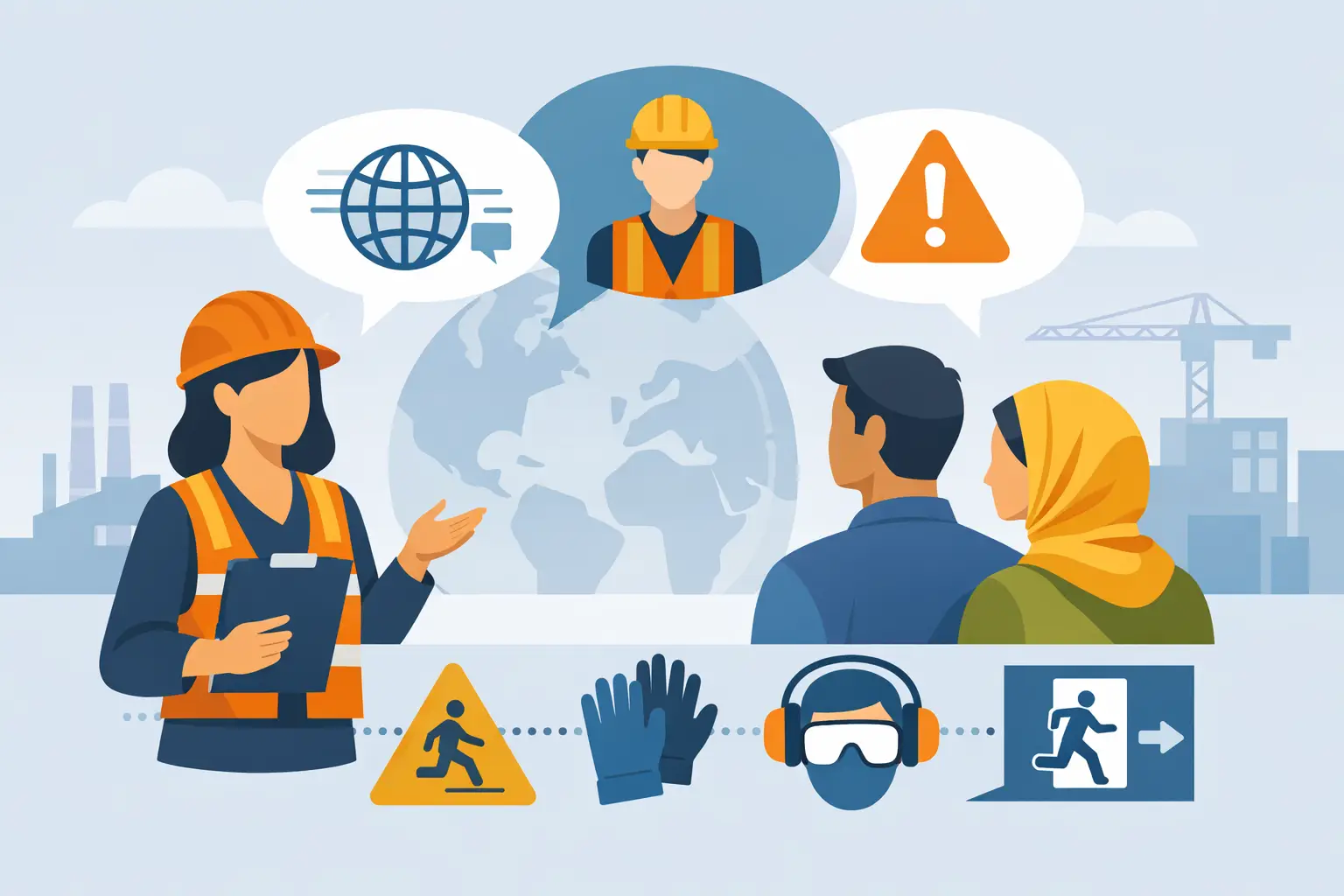
A near miss on a construction or production site rarely starts with machinery alone. It often starts with a misunderstood instruction, a mistranslated warning, or a worker nodding through training they have not fully understood. This guide to multilingual safety communication is written for industrial businesses that cannot afford ambiguity – not in induction training, not in toolbox talks, and certainly not during critical operations.
Why multilingual safety communication is a risk control
In industrial environments, safety communication is not a soft skill. It is a control measure. If lockout-tagout procedures, confined space entry rules, chemical handling steps, or emergency evacuation instructions are not understood with precision, the risk is immediate and measurable.
That matters even more on multinational projects. A new plant build may involve a German equipment supplier, Hungarian contractors, English-speaking project leads, and specialist teams arriving for commissioning. Everyone may be technically competent. That does not mean they share the same operational vocabulary.
This is where many companies make a costly assumption. They believe basic conversational fluency is enough for safety-critical communication. It is not. A worker may understand everyday English or German and still misinterpret a term related to pressure relief, isolation points, purge procedures, arc flash boundaries, or SAP work order status. In technical settings, partial understanding is a liability.
The real cost of getting it wrong
When safety communication fails, the consequences go beyond compliance.
An unclear instruction can stop a line, delay a shutdown, damage equipment, invalidate training, or trigger a reportable incident. On major projects, one misunderstanding during installation or start-up can create days of rework and significant contractual pressure. In operating plants, confusion over maintenance sequencing or permit conditions can expose personnel and halt production.
There is also a hidden financial layer. If a multilingual training session is poorly interpreted, you do not just risk non-comprehension. You may need to repeat the entire programme, extend contractor time on site, postpone handover, or absorb extra supervision costs. For investors and project managers, that is not a language issue. It is a budget issue.
What effective multilingual safety communication looks like
A practical guide to multilingual safety communication starts with one principle: accuracy must be operational, not just linguistic.
That means the message has to be technically correct, understood by the audience, and delivered in a form they can act on immediately. In practice, that usually requires more than translated signage or a bilingual slide deck.
Effective communication combines several layers. Spoken interpretation is needed for live training, audits, incident briefings, and coordination meetings. Written translation is needed for procedures, permits, work instructions, and emergency documents. Terminology alignment is needed so that the same component, hazard, and action are described consistently across teams.
If one document says „isolate the feeder”, the trainer says „disconnect the line”, and the local team uses a third term entirely, confusion becomes predictable. Consistency reduces decision time and lowers the chance of dangerous assumptions.
Where companies usually fall short
The most common problem is using general language support in a specialist environment.
A general interpreter may handle introductions and scheduling well, but struggle when the discussion turns to torque values, interlock logic, vessel entry conditions, or process deviations. The risk is not always dramatic mistranslation. More often, it is subtle imprecision – close enough to sound acceptable, but inaccurate enough to change meaning.
Another weak point is treating safety communication as a one-off task. A translated induction pack is useful, but it will not cover ad hoc permit discussions, shift handovers, FAT or SAT meetings, incident investigations, or live troubleshooting on the shop floor. Safety communication is continuous. Your language support has to be continuous as well.
Some organisations also rely too heavily on bilingual employees. This is understandable, especially under time pressure. But using a supervisor, engineer, or operator as an informal interpreter creates two problems. First, it distracts them from their actual role. Second, it places safety-critical interpretation in the hands of someone who may know the language but not the discipline of accurate interpreting.
How to build a dependable multilingual safety process
Start with risk mapping. Identify where misunderstanding would have the highest impact. Induction training, contractor onboarding, permit-to-work briefings, emergency procedures, machine commissioning, maintenance shutdowns, and EHS audits usually sit at the top of the list.
Then examine the languages actually used on site, not just the languages listed in project paperwork. It is common to find that official documentation exists in English, while teams operate in Hungarian, German, or other languages during daily work. Safety planning has to reflect reality.
The next step is terminology preparation. Before training starts or contractors arrive, key terms should be standardised. This includes equipment names, hazard labels, process steps, PPE requirements, emergency commands, and role titles. The objective is simple: one concept, one agreed term, across every channel.
After that, match the communication method to the task. A written translation may be enough for static documents. It is not enough for dynamic, high-stakes exchanges such as start-up meetings, operational handovers, or safety investigations. In these settings, a certified technical interpreter with sector knowledge is a control against misunderstanding.
Finally, verify comprehension. This is the step many organisations skip. Do not assume silence means understanding. Ask teams to repeat critical instructions in their own words, demonstrate procedures, or confirm decision points. In safety communication, confirmation is not bureaucracy. It is proof that the message has landed.
The role of technical interpreters in multilingual safety communication
A technical interpreter is not there to make the meeting sound smoother. They are there to preserve meaning under pressure.
In industrial environments, that distinction matters. Safety training often involves specialist terminology, live questions, site-specific examples, and immediate clarification. The interpreter must keep pace with technical content while maintaining precision. If the trainer explains an energy isolation sequence incorrectly, or if a worker’s question about residual pressure is simplified too far, the result can be dangerous.
This is why industry knowledge matters as much as language ability. An interpreter who understands plant operations, engineering processes, and safety systems can recognise the significance of terms that a general linguist might miss. In sectors such as energy, petrochemicals, and automotive manufacturing, that expertise directly supports safer execution.
For businesses operating in Hungary with international teams, this is especially relevant. Multilingual communication often sits at the centre of plant construction, equipment installation, audits, SAP rollouts, and workforce training. BeneDictum Kft. works in exactly these conditions, where technical accuracy is tied to safety, continuity, and commercial outcomes.
It depends: when translation is enough and when live support is essential
Not every task needs on-site interpreting. Some do.
If you are distributing standard PPE guidance or a static emergency contact sheet, high-quality written translation may be sufficient, provided terminology has been checked. If you are running a live permit briefing before hazardous work begins, relying on documents alone is a weak control.
The same applies to training. Pre-translated materials help, but they do not capture spontaneous questions, misunderstandings, or trainer emphasis. If the subject is safety-critical and interactive, live language support is usually the safer decision.
There is also a timing factor. During project planning, remote or document-based support may cover much of the need. During commissioning, shutdowns, audits, and incident response, live interpreting becomes far more valuable because the cost of delay and misunderstanding rises sharply.
A better standard for a multilingual site
The strongest industrial businesses do not treat multilingual safety communication as an admin task to sort out at the last minute. They plan it with the same seriousness as permits, PPE, and method statements.
That means using specialist interpreters where risk is highest, aligning terminology before work begins, and checking understanding instead of assuming it. It also means recognising that language accuracy protects more than people. It protects schedules, compliance, reputation, and capital investment.
If your site depends on more than one working language, safety communication is already a technical issue. The only real question is whether you are controlling it properly before it turns into an operational one.
0 hozzászólás